
200 in Roman Numerals is CC
The Roman numeral for 200 is CC. This number represents a doubling of the fundamental centennial value, created by combining two C symbols through the additive principle of Roman numeral notation.
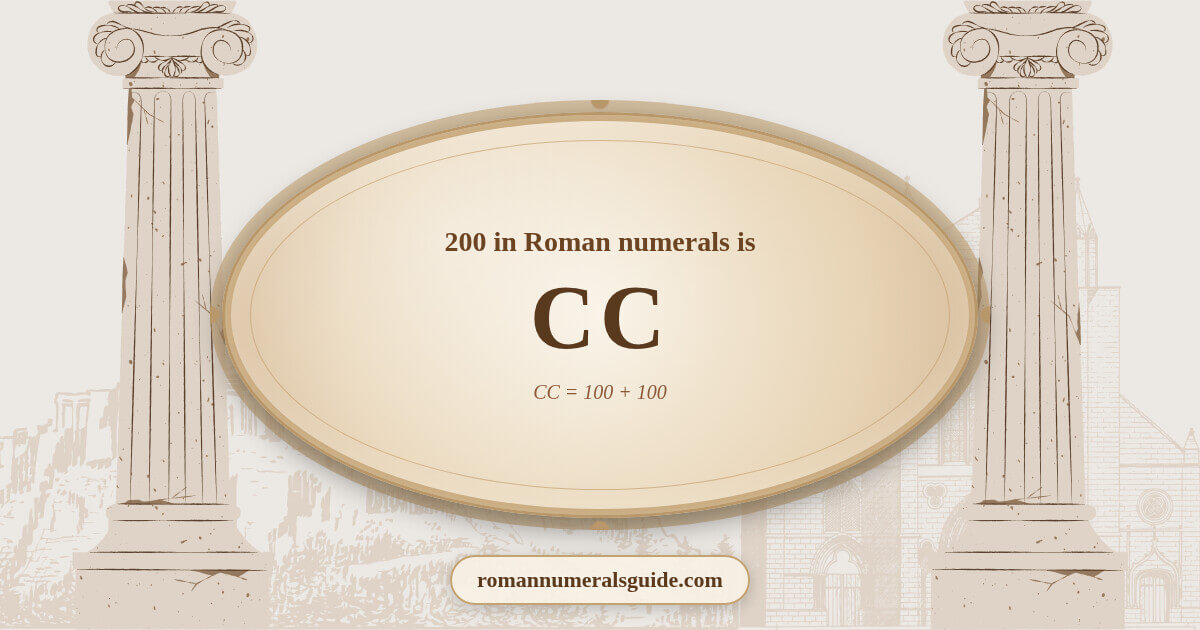
How to write 200 in Roman numerals: CC = 100 + 100
How to Write 200 in Roman Numerals
To write 200 in Roman numerals, we simply repeat the symbol C twice, following the additive principle where each C represents 100.
The Roman numeral system represents 200 as CC, demonstrating the fundamental principle of symbol repetition to create larger values.
Breaking Down 200 (CC)
Step-by-Step Breakdown
The number 200 demonstrates one of the most straightforward principles in Roman numerals: simple repetition of the same symbol to multiply its value. Just as II equals 2 and XX equals 20, CC equals 200.
Correct Representation
Incorrect Representations
Historical Curiosity
In ancient Rome, the number 200 (CC) frequently appeared in military contexts. A double century, consisting of approximately 200 soldiers, was a common tactical unit used for special assignments and operations requiring more force than a single century but less than a full cohort.
Roman civil engineering projects often used measurements in multiples of 100. Roads, aqueducts, and buildings with dimensions of CC (200) Roman feet were common, as this provided practical proportions for construction while maintaining administrative simplicity in record-keeping.
Evolution of 200 in Roman Numerals
The representation of 200 as CC has remained remarkably consistent throughout history, demonstrating the enduring clarity of Roman numeral notation for round numbers.
| Period | Notation | Context |
|---|---|---|
| Ancient Rome (753 BC - 476 AD) | CC | Military records, architectural plans, and census data |
| Medieval Period (476 - 1453 AD) | CC | Manuscript pagination, legal documents, and monastery records |
| Renaissance (1453 - 1600 AD) | CC | Book printing, scientific texts, and artistic inscriptions |
| Modern Era (1600 - Present) | CC | Commemorative dates, formal numbering, and ceremonial uses |
Cultural Applications
- Bicentennial celebrations (200th anniversaries) of nations and institutions
- Chapter and volume numbering in extensive book series
- Commemorative plaques marking 200 years of establishment
- Historical timelines marking events 200 years apart
- Sports events celebrating 200th editions
Decimal System Comparison
The number 200 is a perfect example of how round numbers are represented differently in various numeral systems, each with its own logic.
- • Decimal 200: Three digits using positional notation (2 × 100)
- • Roman CC: Two symbols using repetition principle (C + C)
- • Efficiency: Roman notation is particularly elegant for 200
- • Pattern: Follows the same logic as II (2), XX (20), and CC (200)
Numbers Around 200
Understanding how Roman numerals progress around 200 helps grasp the systematic approach to representing numbers in the second and third centuries.
| Arabic | Roman | Explanation |
|---|---|---|
| 150 | CL | One hundred plus fifty: 100 + 50 |
| 190 | CXC | One hundred plus ninety: 100 + (100-10) |
| 199 | CXCIX | One hundred ninety-nine: 100 + 90 + 9 |
| 200 | CC | Two hundred: 100 + 100 |
| 201 | CCI | Two hundred one: 200 + 1 |
| 250 | CCL | Two hundred fifty: 200 + 50 |
| 300 | CCC | Three hundred: 100 + 100 + 100 |
Notice how CC (200) serves as a natural milestone in Roman numeral progression, providing a clean foundation for building numbers in the third century.
Why CC is Simple
The number 200 (CC) represents pure additive notation at its most elegant, requiring no subtraction and following the natural pattern of symbol repetition.
Simplicity of CC
- Pure addition with no subtraction needed
- Direct repetition of the same symbol (C)
- Follows the universal pattern: II (2), XX (20), CC (200)
- Easy to read and write with no ambiguity
- Demonstrates the elegance of Roman numeral system
Memory Tips for CC
Remembering that CC equals 200 is straightforward when you understand the repetition principle.
The Doubling Pattern
Think of CC as "Century plus Century" - two hundreds make two hundred. Just as two tens (XX) make twenty, two hundreds (CC) make two hundred.
Remember the progression: C (100), CC (200), CCC (300). Each additional C adds 100, following the same pattern as I, II, III for units.
200 in the Modern World
Anniversaries
Bicentennial celebrations marking 200 years of nations, organizations, and historic events
Athletics
200-meter race, one of the most prestigious sprint distances in Olympic athletics
Commerce
Common price point ($200) and benchmark in financial planning and budgeting
Mathematical Significance
200 is a highly composite number with exceptional mathematical properties. It is divisible by many numbers, making it useful in practical calculations and divisions. As 2 × 100, it represents a doubling of the centennial value.
Mathematical Properties of 200
The number 200 possesses several interesting mathematical characteristics that make it particularly useful in various applications.
- Composite number with prime factorization 2³ × 5² (8 × 25)
- Highly divisible: has 12 divisors (1, 2, 4, 5, 8, 10, 20, 25, 40, 50, 100, 200)
- Even number divisible by common values like 2, 4, 5, 8, 10, 20, 25, 50
- Perfect for percentage calculations (200% = double)
- Sum of eight consecutive prime numbers: 11 + 13 + 17 + 19 + 23 + 29 + 31 + 37
Did You Know?
200 is the HTTP status code for "OK" in web communications, making it one of the most commonly seen numbers in internet technology. Every successful webpage load returns this status code.
Counting in Hundreds
Understanding the pattern of hundreds in Roman numerals shows the elegant simplicity of the system for round numbers.
- C (100) → CC (200) → CCC (300) → CD (400)
- The pattern shows simple repetition up to three times, then subtraction for 400
- Each C adds exactly 100 to the total, following the additive principle
- The system maintains clarity even as numbers grow larger
Frequently Asked Questions
Why is 200 written as CC instead of other combinations?
CC is the standard and most efficient way to write 200 in Roman numerals. It follows the fundamental repetition principle: since C = 100, repeating it twice (CC) naturally represents 200. This follows the same logic as II for 2 and XX for 20.
Could 200 be written differently in Roman numerals?
No, CC is the only correct standard representation of 200 in classical Roman numerals. Alternative notations like "DD" would be incorrect since D represents 500, not related to 200. The Roman system has specific rules that make CC the unambiguous representation.
What is a bicentennial and why does it use Roman numerals?
A bicentennial is a 200-year anniversary. Roman numerals are often used for commemorative purposes because they convey formality and historical significance. Many nations and institutions celebrate their bicentennials with inscriptions using CC to mark 200 years.
How does the 200-meter race relate to Roman numerals?
The 200-meter dash is one of the premier events in track and field. While the distance is measured in metric units, commemorative medals and historical records sometimes use CC to denote the distance, connecting athletic achievement with classical tradition.
Why is 200 such a common number in everyday life?
200 appears frequently because it is a round, easily divisible number. In commerce, $200 is a common price point. In athletics, 200 meters is a standard race distance. In history, bicentennials mark significant 200-year milestones. Its mathematical properties make it practical for many applications.
What comes after CC in Roman numerals?
After CC (200), you continue with CCI (201), CCII (202), and so on. The pattern builds on CC as the base for all numbers from 201 to 299, adding the appropriate symbols for units and tens.
Is CC used in modern contexts?
Yes, CC appears in commemorative plaques, anniversary celebrations, chapter numbering in books, formal document pagination, and architectural inscriptions. It is particularly common for marking bicentennial (200-year) celebrations of institutions and nations.
Summary
Key Points About CC
- CC represents 200 using simple symbol repetition
- Follows the pattern: C (100), CC (200), CCC (300)
- Pure additive notation with no subtraction
- One of the most elegant representations in Roman numerals
Modern Usage
- Bicentennial (200-year) celebrations
- 200-meter race in athletics
- Common price point and financial benchmark
- HTTP status code 200 (OK) in web technology
The Roman numeral CC (200) exemplifies the elegant simplicity of repetition in Roman notation. As a bicentennial marker, an athletic distance, and a mathematical milestone, 200 holds significance across history and modern life. The notation CC demonstrates how Roman numerals efficiently represent round numbers through straightforward doubling of fundamental symbols, making it one of the clearest and most memorable representations in the entire system.
Converting number 200 to Roman
This is the number 200 written in Roman numerals
Try the Roman numeral converter
Want to convert other numbers? Use our converter: