
129 in Roman Numerals is CXXIX
The Roman numeral for 129 is CXXIX. This number combines additive and subtractive notation, representing one hundred plus twenty plus nine, and holds special mathematical significance as the sum of the first ten prime numbers.
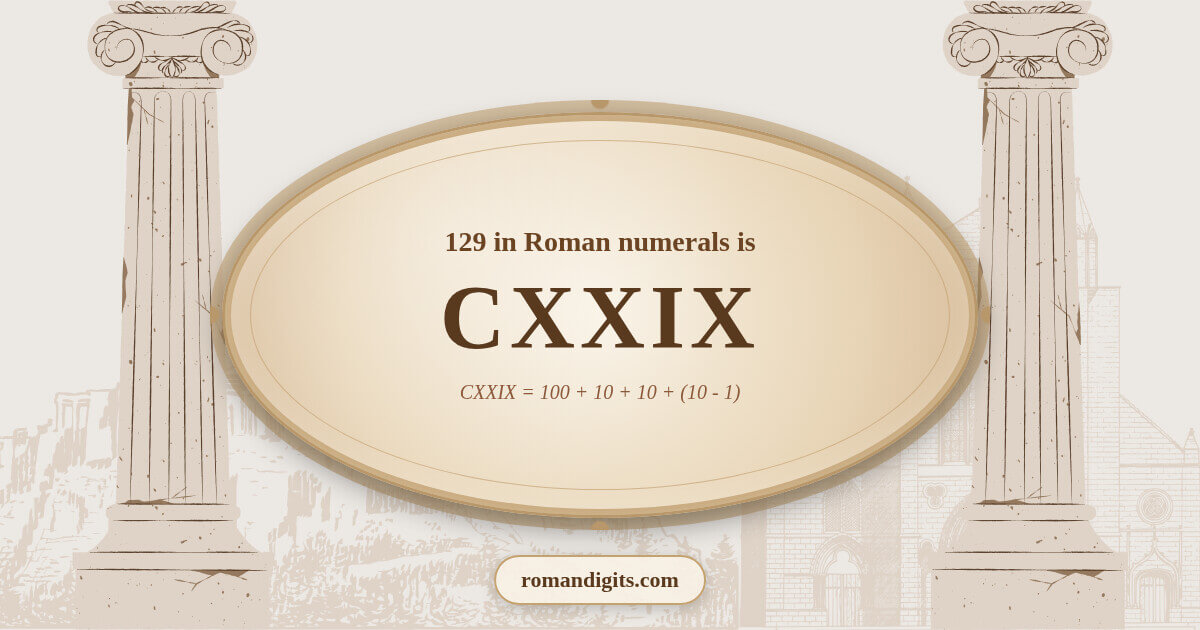
How to write 129 in Roman numerals: CXXIX = 100 + 20 + 9
How to Write 129 in Roman Numerals
To write 129 in Roman numerals, we combine C (100), XX (20), and IX (9) following both additive and subtractive principles.
The Roman numeral system represents 129 as CXXIX. This notation starts with the largest value C (100), adds XX (20), and concludes with the subtractive form IX (9), where I before X means "one before ten".
Breaking Down 129 (CXXIX)
Step-by-Step Breakdown
The number 129 demonstrates both additive and subtractive Roman numeral principles. The C and XX combine through addition, while IX uses the subtractive rule where a smaller numeral (I) placed before a larger one (X) indicates subtraction.
✅ Correct Representation
❌ Incorrect Representations
Historical and Biblical Significance
Psalm 129 is one of the "Songs of Ascents" in the Hebrew Bible, sung by Jewish pilgrims traveling to Jerusalem for religious festivals. This psalm reflects themes of perseverance and deliverance from oppression throughout Israel's history.
In early Christian history, believers faced persecution for 129 of the 249 years between 64 and 313 AD. This period ended with the Edict of Milan under Emperor Constantine, which granted legal status to Christianity and ended imperial persecution.
The approximate distance from Nazareth to Bethlehem, the journey Mary and Joseph undertook before Jesus' birth, is roughly 129 kilometers (80 miles), a significant journey in ancient times.
Evolution of 129 in Roman Numerals
The representation of 129 as CXXIX has remained consistent throughout history, demonstrating the stability of combined additive and subtractive Roman numeral notation.
| Period | Notation | Context |
|---|---|---|
| Ancient Rome (753 BC - 476 AD) | CXXIX | Military records, census data, and historical documentation |
| Medieval Period (476 - 1453 AD) | CXXIX | Religious texts, including psalm numbering and biblical references |
| Modern Era (1453 - Present) | CXXIX | Chapter numbering, formal documentation, and mathematical education |
Cultural and Religious Applications
- Psalm 129 in the Hebrew Bible and Christian Old Testament
- Historical marker for the duration of early Christian persecution
- Mathematical education as the sum of the first ten prime numbers
- Chapter and verse numbering in religious and classical texts
- Reference point in historical distance measurements (Nazareth to Bethlehem)
Decimal System Comparison
The number 129 showcases the efficiency of both decimal and Roman numeral systems for representing numbers in the second century.
- • Decimal 129: Three digits using positional notation
- • Roman CXXIX: Five symbols combining additive and subtractive notation
- • Mathematical property: 129 is the sum of the first 10 prime numbers
- • Prime factorization: 3 × 43 (product of two prime numbers)
Progression Examples Around 129
Understanding how Roman numerals progress around 129 demonstrates the systematic combination of additive and subtractive principles.
| Arabic | Roman | Explanation |
|---|---|---|
| 126 | CXXVI | Pure addition: 100 + 20 + 6 |
| 127 | CXXVII | Pure addition: 100 + 20 + 7 |
| 128 | CXXVIII | Pure addition: 100 + 20 + 8 |
| 129 | CXXIX | Mixed notation: 100 + 20 + (10-1) |
| 130 | CXXX | Pure addition: 100 + 30 |
Notice how 129 (CXXIX) transitions from additive notation to include subtractive notation with IX, demonstrating the systematic approach to representing nine.
Understanding CXXIX Construction
The number 129 (CXXIX) combines both additive and subtractive Roman numeral principles, making it an excellent example of mixed notation.
How CXXIX is Built
- C (100) uses simple representation for hundreds
- XX (20) uses additive repetition for twenty
- IX (9) uses subtractive notation where I before X means "one before ten"
- Symbols arranged in descending value order: C > XX > IX
- Subtractive notation only at the end avoids confusion
Memory Tips for CXXIX
Remembering CXXIX becomes easier when you break it into meaningful components and recognize the pattern.
Pattern Recognition Strategy
Think of CXXIX as "Century (C) + Two Tens (XX) + Nine (IX)". The structure follows a natural breakdown: 100 + 20 + 9.
Remember that IX is the standard way to write 9 in Roman numerals, appearing in 9, 19, 29, and so on. This pattern makes CXXIX follow logically from CXXVIII (128).
Connect CXXIX to its mathematical uniqueness: it's the sum of the first ten prime numbers (2+3+5+7+11+13+17+19+23+29 = 129), making it memorable for mathematics enthusiasts.
129 in the Modern World
Mathematics
Sum of the first 10 prime numbers, used in number theory education
Religion
Psalm 129 in biblical texts and religious study
History
Duration of early Christian persecution (129 years)
Mathematical Significance
129 holds a unique place in mathematics as the sum of the first ten prime numbers (2+3+5+7+11+13+17+19+23+29 = 129). As a composite number with prime factorization 3 × 43, it represents the product of two prime numbers. The sum of all factors of 129 (1+3+43+129) equals 176.
Mathematical Properties of 129
The number 129 possesses several fascinating mathematical properties that make it particularly interesting in number theory.
- Composite number with prime factorization 3 × 43
- Sum of the first ten prime numbers: 2+3+5+7+11+13+17+19+23+29 = 129
- Has exactly 4 divisors: 1, 3, 43, and 129
- Sum of all divisors equals 176
- Odd composite number (not divisible by 2)
- 84 positive integers less than 129 are relatively prime to it
Did You Know?
129 is the smallest number that is the sum of the first ten prime numbers. This property makes it a significant teaching example in mathematics education, particularly when introducing students to prime numbers and their relationships.
Counting with Roman Numerals Around 129
Understanding the sequence around 129 demonstrates the transition from purely additive to mixed notation in Roman numerals.
- CXXVI (126) → CXXVII (127) → CXXVIII (128) → CXXIX (129) → CXXX (130)
- The pattern shows how Roman numerals transition from CXXVIII to CXXIX by replacing VIII (8) with IX (9)
- After CXXIX, the system simplifies to CXXX (130), demonstrating the efficiency of Roman notation at decade boundaries
Frequently Asked Questions
Why is 129 written as CXXIX instead of CXXVIIII?
Roman numeral convention uses subtractive notation for 9, writing it as IX (one before ten) rather than VIIII (five plus four ones). This makes CXXIX the correct and more efficient representation, following the standard rule that I can precede X to indicate subtraction.
What makes 129 mathematically special?
129 is the sum of the first ten prime numbers (2+3+5+7+11+13+17+19+23+29 = 129). This unique property makes it significant in number theory and mathematics education. Additionally, 129 is a composite number with the prime factorization 3 × 43.
What is the biblical significance of 129?
Psalm 129 is one of the Songs of Ascents in the Bible, traditionally sung by pilgrims traveling to Jerusalem. Additionally, early Christians faced persecution for 129 of the 249 years between 64 and 313 AD, making this number historically significant in Christian history.
How do you count from 129 to 130 in Roman numerals?
From CXXIX (129), you move to CXXX (130). This transition simplifies the notation because 130 is three tens (XXX) plus one hundred (C), eliminating the subtractive notation used in IX.
Can I write 129 as IXL instead of CXXIX?
No, IXL is not a valid Roman numeral representation. Roman numeral rules prohibit subtracting I from L. The subtractive principle only allows I before V or X, not before L. CXXIX is the only correct way to write 129 in Roman numerals.
How is CXXIX broken down into its components?
CXXIX breaks down into three parts: C (100) + XX (20) + IX (9). The C represents one hundred, XX represents two tens making twenty, and IX uses subtractive notation where I before X means nine (one before ten). Together: 100 + 20 + 9 = 129.
Why does 129 use mixed notation in Roman numerals?
CXXIX uses mixed notation because it combines additive principles (C + XX) with subtractive notation (IX). This demonstrates the flexibility of the Roman numeral system, using the most efficient representation for each component: addition for hundreds and twenties, subtraction for nine.
Summary
Key Points About CXXIX
- CXXIX represents 129 using mixed additive and subtractive notation
- Breaks down as C (100) + XX (20) + IX (9)
- IX demonstrates subtractive notation: I before X means "one before ten"
- Symbols arranged in descending order of value
Significance and Applications
- Sum of the first ten prime numbers (mathematical education)
- Psalm 129 in biblical and religious contexts
- Historical reference to early Christian persecution period
- Chapter and verse numbering in classical texts
The Roman numeral CXXIX (129) perfectly illustrates how the Roman numeral system combines additive and subtractive principles for efficient representation. Beyond its notation, 129 holds unique mathematical significance as the sum of the first ten prime numbers and cultural importance through biblical references and historical events. Understanding CXXIX provides insight into both the flexibility of Roman numerals and the rich historical context surrounding this number.
Converting number 129 to Roman
This is the number 129 written in Roman numerals
Try the Roman numeral converter
Want to convert other numbers? Use our converter: