
130 in Roman Numerals is CXXX
The Roman numeral for 130 is CXXX. This number combines one hundred with thirty through pure additive notation, and holds profound significance both mathematically as a unique sphenic number and spiritually as the number of the famous penitential Psalm 130, "De Profundis".
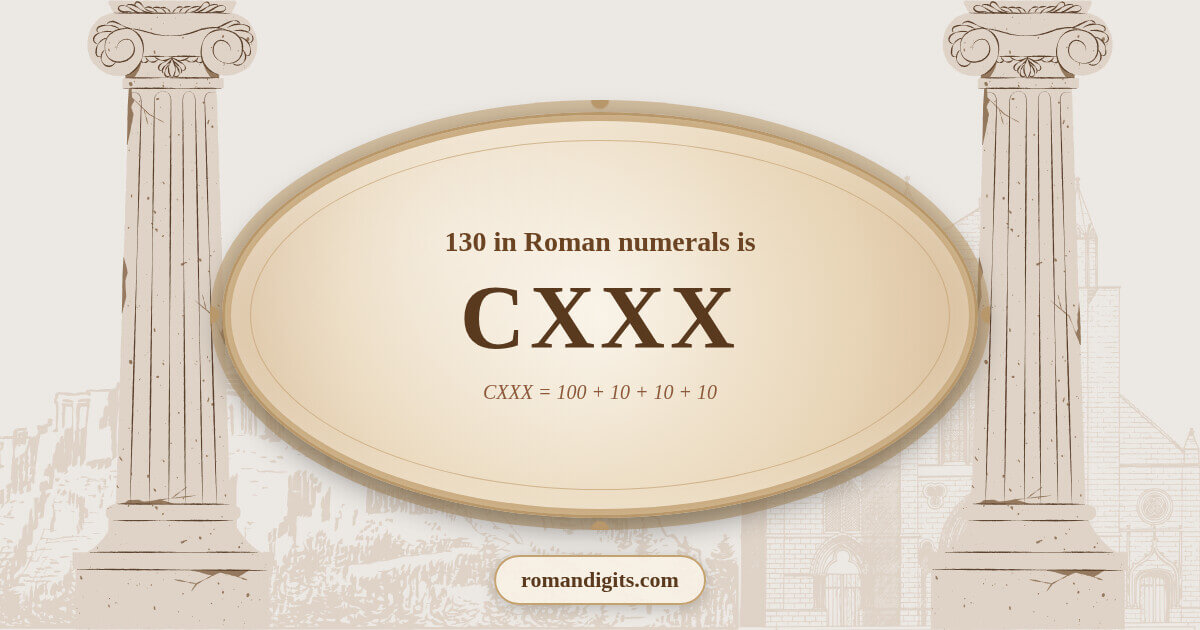
How to write 130 in Roman numerals: CXXX = 100 + 30
How to Write 130 in Roman Numerals
To write 130 in Roman numerals, we combine C (100) with XXX (30) using straightforward additive notation.
The Roman numeral system represents 130 as CXXX, following pure additive principles where C (100) is followed by XXX (three tens), creating a clean and elegant representation of this decade milestone.
Breaking Down 130 (CXXX)
Step-by-Step Breakdown
The number 130 demonstrates pure additive Roman numeral construction at its simplest. With C representing one hundred and XXX representing thirty through triple repetition, CXXX requires no subtractive notation, making it exceptionally clear and easy to read.
✅ Correct Representation
❌ Incorrect Representations
Spiritual and Historical Significance
Psalm 130, known in Latin as "De Profundis" (Out of the Depths), is one of the seven penitential psalms and among the fifteen Songs of Ascents. Opening with the profound cry "Out of the depths I cry to you, O Lord," this psalm has been central to Christian liturgy since the Rule of St. Benedict around 530 CE assigned it to Tuesday vespers.
Martin Luther called Psalm 130 "a proper master and doctor of Scripture." He paraphrased it into the hymn "Aus tiefer Not schrei ich zu dir" (Out of deep distress I cry to you), which became foundational to Protestant worship and inspired compositions by Bach, Mendelssohn, and Reger.
Pope Clement XII, through his brief "Caelestes Ecclesiae thesauros" promulgated on August 14, 1736, encouraged Christians to pray Psalm 130 daily for souls in Purgatory. The psalm also forms part of Jewish High Holiday liturgy, recited before the open Torah ark from Rosh Hashanah until Yom Kippur.
Oscar Wilde's famous prison letter to Lord Alfred Douglas was posthumously titled "De Profundis," borrowing the psalm's name to capture themes of suffering, redemption, and hope from the depths of despair.
Evolution of 130 in Roman Numerals
The representation of 130 as CXXX has remained remarkably consistent throughout history, exemplifying the stability of straightforward additive Roman numeral notation.
| Period | Notation | Context |
|---|---|---|
| Ancient Rome (753 BC - 476 AD) | CXXX | Military unit sizes, census records, and architectural measurements |
| Medieval Period (476 - 1453 AD) | CXXX | Psalm numbering, manuscript pagination, and liturgical texts |
| Renaissance to Modern (1453 - Present) | CXXX | Religious texts, formal numbering, and mathematical education |
Cultural and Religious Applications
- Psalm 130 (De Profundis) in Christian, Jewish, and musical traditions
- Martin Luther's hymn "Aus tiefer Not schrei ich zu dir" and its musical legacy
- Catholic prayers for the dead since Pope Clement XII (1736)
- Jewish High Holiday liturgy from Rosh Hashanah to Yom Kippur
- Oscar Wilde's prison letter "De Profundis" literary reference
- Mathematical education demonstrating sphenic and happy numbers
Decimal System Comparison
The number 130 represents a clean decade milestone in both decimal and Roman numeral systems, showcasing elegant simplicity.
- • Decimal 130: Three digits representing one hundred and three tens
- • Roman CXXX: Four symbols using pure additive notation
- • Mathematical property: 130 is a sphenic number (product of three distinct primes)
- • Prime factorization: 2 × 5 × 13
- • Unique property: 130 = 1² + 2² + 5² + 10² (sum of squares of first four divisors)
Progression Examples Around 130
Understanding how Roman numerals progress around 130 demonstrates the elegant transition at decade boundaries.
| Arabic | Roman | Explanation |
|---|---|---|
| 127 | CXXVII | Addition with units: 100 + 20 + 7 |
| 128 | CXXVIII | Addition with units: 100 + 20 + 8 |
| 129 | CXXIX | Mixed notation: 100 + 20 + (10-1) |
| 130 | CXXX | Pure addition at decade boundary: 100 + 30 |
| 131 | CXXXI | Addition continues: 100 + 30 + 1 |
Notice how 130 (CXXX) represents a decade boundary, simplifying from the complex CXXIX (129) to the clean combination of C and XXX.
Additive Rules for CXXX
The number 130 (CXXX) demonstrates pure additive Roman numeral construction without any subtractive elements, making it one of the most straightforward representations.
Why CXXX is Simple
- Pure addition: C + XXX with no subtraction needed
- XXX efficiently represents thirty through triple repetition
- Follows descending value order (C before XXX)
- Represents a clean decade boundary (13 tens)
- No ambiguity or complexity in reading or writing
Memory Tips for CXXX
Remembering CXXX is straightforward due to its logical structure and decade boundary position.
Pattern Recognition Strategy
Think of CXXX as "Century (C) + Three Tens (XXX)". The structure mirrors the decimal system: 100 + 30 = 130.
Remember the decade pattern: CXX (120), CXXX (130), CXL (140). Each represents a clean multiple of ten added to one hundred.
Connect CXXX to Psalm 130 "De Profundis" - one of the most famous psalms in Christian and Jewish tradition. This cultural association makes the number memorable.
Recognize that XXX uses the maximum efficient repetition (three X symbols), making 130 the last number in this pattern before transitioning to XL (40) combinations.
130 in the Modern World
Mathematics
Sphenic number and happy number in number theory
Religion
Psalm 130 "De Profundis" in liturgical traditions worldwide
Music
Luther's hymn inspired compositions by Bach and others
Mathematical Significance
130 possesses a truly unique mathematical property: it equals the sum of the squares of its first four divisors (1² + 2² + 5² + 10² = 1 + 4 + 25 + 100 = 130). As a sphenic number with prime factorization 2 × 5 × 13, it is the product of three distinct prime numbers. Additionally, 130 is a happy number: iteratively summing the squares of its digits yields 1 (130 → 10 → 1).
Mathematical Properties of 130
The number 130 possesses several remarkable mathematical properties that make it exceptional in number theory.
- Sphenic number: product of three distinct primes (2 × 5 × 13)
- Happy number: 130 → 1² + 3² + 0² = 10 → 1² + 0² = 1
- Unique property: 130 = 1² + 2² + 5² + 10² (sum of squares of first four divisors)
- Has exactly 8 divisors: 1, 2, 5, 10, 13, 26, 65, 130
- Deficient number: sum of proper divisors (122) is less than 130
- Sum of all divisors equals 252
- Euler's totient function φ(130) = 48
- Largest integer that cannot be expressed as sum of four hexagonal numbers
Did You Know?
130 is the only positive integer that equals the sum of the squares of its first four divisors. This remarkable property makes it unique in all of mathematics, highlighting an elegant relationship between a number and its divisors that appears nowhere else in the number system.
Counting with Roman Numerals Around 130
Understanding the sequence around 130 demonstrates the elegant simplification that occurs at decade boundaries in Roman numerals.
- CXXVII (127) → CXXVIII (128) → CXXIX (129) → CXXX (130) → CXXXI (131)
- The pattern shows how CXXIX (with subtractive IX) simplifies to CXXX at the decade boundary
- After 130, counting continues by adding units to CXXX: CXXXI, CXXXII, CXXXIII, and so forth
Frequently Asked Questions
Why is 130 written as CXXX instead of CXL minus X?
Roman numerals use the most direct representation possible. CXXX (100 + 30) follows the additive principle clearly, while "CXL minus X" would be needlessly complex and violate Roman numeral conventions. CXL represents 140, not 130, and Roman numerals don't use subtraction of this type.
What is the biblical significance of 130?
Psalm 130, "De Profundis" (Out of the Depths), is one of the seven penitential psalms and has been central to Christian and Jewish liturgy for centuries. Martin Luther called it "a proper master and doctor of Scripture." It has inspired countless hymns, musical compositions, and prayers, including Catholic prayers for the dead since 1736.
What makes 130 mathematically unique?
130 is the only positive integer in all of mathematics that equals the sum of the squares of its first four divisors: 1² + 2² + 5² + 10² = 130. This extraordinary property makes it genuinely one-of-a-kind. It is also a sphenic number (2 × 5 × 13) and a happy number.
How do you pronounce CXXX in Roman numerals?
CXXX is pronounced as "one hundred thirty" or "centum triginta" in Latin. Each component is read sequentially: C (one hundred) followed by XXX (thirty).
What is a happy number, and why is 130 one?
A happy number is one where repeatedly summing the squares of its digits eventually yields 1. For 130: 1² + 3² + 0² = 10, then 1² + 0² = 1. Reaching 1 confirms that 130 is a happy number, a playful but mathematically significant property.
Why is Psalm 130 called "De Profundis"?
De Profundis is Latin for "Out of the depths," the opening words of Psalm 130. The psalm begins "Out of the depths I cry to you, O Lord," expressing a soul's cry from the depths of despair to God. This Latin title has been used since early Christianity and remains the psalm's traditional name.
Can CXXX be simplified further?
No, CXXX is already in its simplest and most efficient form. Using pure additive notation with C (100) and XXX (30), it represents 130 clearly without any subtractive complexity. Any alternative would be longer or violate Roman numeral conventions.
Summary
Key Points About CXXX
- CXXX represents 130 using pure additive notation
- Breaks down as C (100) + XXX (30)
- Represents a decade boundary with elegant simplicity
- No subtractive notation required
Significance and Applications
- Psalm 130 "De Profundis" in liturgical traditions worldwide
- Martin Luther's hymn and its musical legacy (Bach, Mendelssohn)
- Unique mathematical properties (sum of squares of divisors)
- Sphenic and happy number in number theory
The Roman numeral CXXX (130) represents both mathematical elegance and profound spiritual significance. Mathematically, 130 stands alone as the only number equal to the sum of squares of its first four divisors, while also being a sphenic and happy number. Spiritually, as Psalm 130 "De Profundis," it has inspired liturgy, hymns, and prayers across Christian and Jewish traditions for nearly two millennia. Understanding CXXX provides insight into the simplicity of additive Roman notation at decade boundaries and the rich cultural heritage surrounding this remarkable number.
Converting number 130 to Roman
This is the number 130 written in Roman numerals
Try the Roman numeral converter
Want to convert other numbers? Use our converter: