
300 in Roman Numerals is CCC
The Roman numeral for 300 is CCC. This number represents the maximum repetition of the symbol C, showcasing one of the fundamental rules in Roman numeral notation where a symbol can be repeated up to three times.
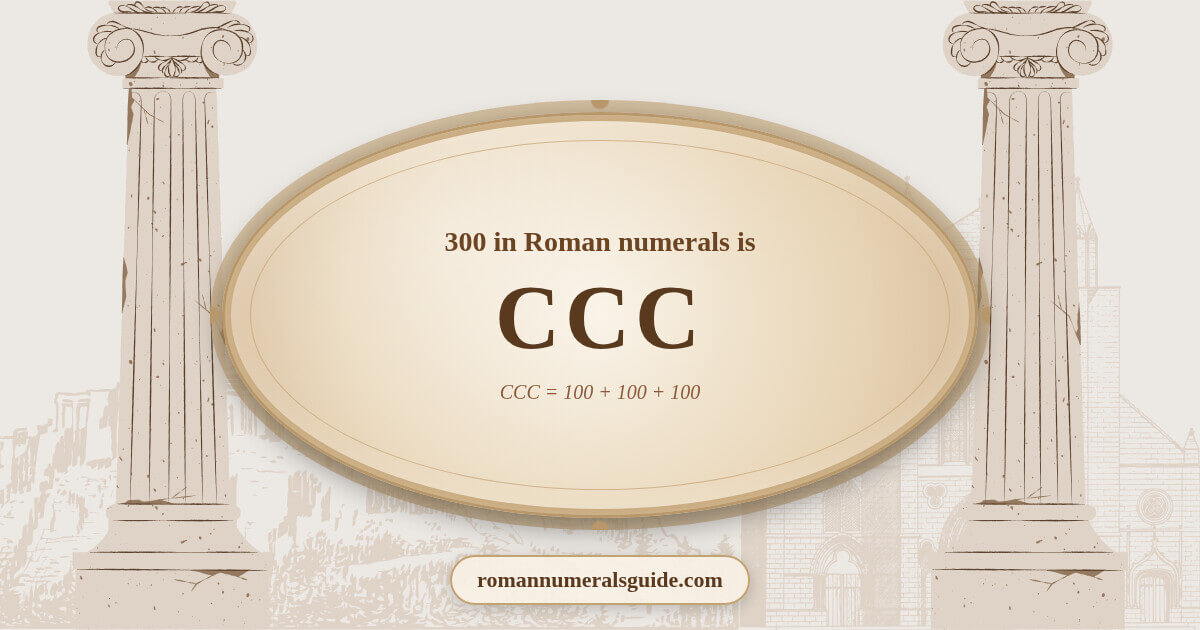
How to write 300 in Roman numerals: CCC = 100 + 100 + 100
How to Write 300 in Roman Numerals
To write 300 in Roman numerals, we repeat the symbol C three times, following the additive principle. This is the maximum number of times C can be repeated before requiring a different notation approach.
The Roman numeral system represents 300 as CCC, demonstrating the maximum repetition rule where any symbol can appear consecutively up to three times.
Breaking Down 300 (CCC)
Step-by-Step Breakdown
The number 300 demonstrates the maximum repetition rule in Roman numerals. Just as III represents 3 and XXX represents 30, CCC represents 300. After three repetitions, the system transitions to subtractive notation, making 400 written as CD rather than CCCC.
Correct Representation
Incorrect Representations
Historical Significance
The number 300 holds legendary status in ancient history due to the Battle of Thermopylae in 480 BCE, where approximately 300 Spartan warriors, led by King Leonidas, made their famous stand against the massive Persian army. This heroic defense became one of the most celebrated military actions in history, symbolizing courage and determination against overwhelming odds.
In Roman military organization, a cohort typically consisted of around 300 to 600 soldiers, representing a significant tactical unit. The number 300 (CCC) frequently appeared in military records, census data, and administrative documents throughout the Roman Empire, marking it as a standard reference point for large quantities.
Evolution of 300 in Roman Numerals
The representation of 300 as CCC has remained consistent throughout history, exemplifying the stability and clarity of Roman numeral maximum repetition principles.
| Period | Notation | Context |
|---|---|---|
| Ancient Rome (753 BC - 476 AD) | CCC | Military cohort sizes, census records, and architectural measurements |
| Medieval Period (476 - 1453 AD) | CCC | Manuscript chapter numbering and monastery inventories |
| Renaissance (1453 - 1600 AD) | CCC | Book pagination and scientific documentation |
| Modern Era (1600 - Present) | CCC | Commemorative inscriptions and formal numbering systems |
Cultural Applications
- Film "300" (2006) depicting the Battle of Thermopylae
- Tricentennial celebrations marking 300-year anniversaries
- Chrysler 300 automobile series naming
- Page CCC in extensive book collections and encyclopedias
- Historical commemorations of 300-year institutional milestones
Decimal System Comparison
The number 300 demonstrates how maximum repetition works across different numeral systems, each approaching the representation of three hundred differently.
- • Decimal 300: Three digits using positional notation (3 × 100)
- • Roman CCC: Three symbols at maximum repetition (C + C + C)
- • Repetition limit: CCC shows the boundary before transition to CD (400)
- • Pattern consistency: III (3), XXX (30), CCC (300) follow same rule
Numbers Around 300
Understanding how Roman numerals progress around 300 demonstrates the transition from maximum repetition to subtractive notation at 400.
| Arabic | Roman | Explanation |
|---|---|---|
| 250 | CCL | Two hundred fifty: 200 + 50 |
| 290 | CCXC | Two hundred ninety: 200 + 90 |
| 299 | CCXCIX | Two hundred ninety-nine: 200 + 90 + 9 |
| 300 | CCC | Three hundred: 100 + 100 + 100 |
| 301 | CCCI | Three hundred one: 300 + 1 |
| 350 | CCCL | Three hundred fifty: 300 + 50 |
| 400 | CD | Four hundred: 500 - 100 (NOT CCCC) |
Notice that after CCC (300), the system continues with additive notation until 400, where it transitions to subtractive notation (CD) rather than violating the three-repetition limit with CCCC.
The Maximum Repetition Rule
The number 300 (CCC) represents the maximum allowable repetition of the symbol C before the system requires a different approach for larger values.
Why CCC is the Limit
- Roman numerals allow maximum three consecutive repetitions of the same symbol
- CCC demonstrates this limit: three hundreds require three C symbols
- 400 cannot be written as CCCC; it must use subtractive notation: CD
- This rule applies universally: III (3), XXX (30), CCC (300)
- The limit prevents unwieldy notation for larger numbers
Memory Tips for CCC
Remembering that CCC equals 300 is straightforward when you understand the triple repetition pattern.
The Triple Pattern
Think of CCC as "Century three times" - three hundreds make three hundred. This follows the universal pattern: I-II-III for units, X-XX-XXX for tens, and C-CC-CCC for hundreds.
Remember the famous "300 Spartans" at Thermopylae - their number in Roman numerals would be CCC. This historical connection helps cement the notation in memory.
300 in the Modern World
Entertainment
Film "300" (2006) depicting the Battle of Thermopylae, Chrysler 300 automobile series
History
Tricentennial celebrations marking 300-year anniversaries of institutions and nations
Sports
Bowling perfect game score is 300 points, representing 12 consecutive strikes
Mathematical Significance
300 is a highly composite number with numerous divisors, making it exceptionally useful for practical calculations and divisions. It is both a triangular number (the sum of the first 24 positive integers) and a Harshad number (divisible by the sum of its digits).
Mathematical Properties of 300
The number 300 possesses exceptional mathematical characteristics that make it significant in number theory and practical applications.
- Composite number with prime factorization 2² × 3 × 5² (4 × 3 × 25)
- Highly divisible: has 18 divisors (1, 2, 3, 4, 5, 6, 10, 12, 15, 20, 25, 30, 50, 60, 75, 100, 150, 300)
- Triangular number: sum of integers from 1 to 24 equals 300
- Harshad number: divisible by sum of its digits (300 ÷ 3 = 100)
- Perfect score in ten-pin bowling (12 strikes)
Did You Know?
300 is the maximum possible score in ten-pin bowling, achieved by rolling 12 consecutive strikes. This perfect game is one of the most celebrated achievements in bowling and sports, making 300 an iconic number in athletic culture.
Counting in Hundreds
Understanding the progression of hundreds in Roman numerals reveals the elegant transition from additive to subtractive notation.
- C (100) → CC (200) → CCC (300) → CD (400)
- CCC represents maximum repetition before system transition
- After 300, the notation shifts from pure addition to subtraction for efficiency
- Pattern mirrors units (I-II-III-IV) and tens (X-XX-XXX-XL)
Frequently Asked Questions
Why is 300 written as CCC and not another way?
CCC is the only correct representation of 300 in Roman numerals. It follows the fundamental repetition rule where C (100) is repeated three times, the maximum allowed for any symbol. This pattern is consistent across all place values: III (3), XXX (30), and CCC (300).
Why can't 400 be written as CCCC?
Roman numerals have a strict three-repetition limit. After three consecutive identical symbols (like CCC for 300), the system requires subtractive notation. Therefore, 400 is written as CD (500 - 100) rather than CCCC. This rule prevents unwieldy sequences and maintains clarity.
What is the significance of 300 Spartans at Thermopylae?
At the Battle of Thermopylae in 480 BCE, approximately 300 Spartan warriors led by King Leonidas made a legendary stand against the massive Persian army. This battle became one of history's most celebrated examples of courage and military valor, immortalized in literature, art, and the 2006 film "300."
Why is 300 important in bowling?
300 is the perfect score in ten-pin bowling, achieved by rolling 12 consecutive strikes. This perfect game represents the absolute peak of bowling performance and is considered one of the most prestigious achievements in the sport, celebrated worldwide among bowlers.
What is a tricentennial?
A tricentennial is a 300-year anniversary. Many nations, institutions, and cities celebrate their tricentennials with special commemorations, often using the Roman numeral CCC in official inscriptions and ceremonies to denote the 300-year milestone.
How does 300 relate to triangular numbers?
300 is a triangular number, meaning it equals the sum of consecutive integers starting from 1. Specifically, 1 + 2 + 3 + ... + 24 = 300. This property makes 300 significant in mathematics and geometry, where triangular numbers have special applications.
Is CCC used in modern contexts?
Yes, CCC appears in commemorative inscriptions for 300-year anniversaries (tricentennials), chapter numbering in extensive works, formal document pagination, and architectural inscriptions. The film "300" popularized the Roman numeral connection to the famous battle.
Summary
Key Points About CCC
- CCC represents 300 using maximum symbol repetition
- Demonstrates the three-repetition limit in Roman numerals
- After CCC, system transitions to subtractive notation (CD = 400)
- Follows universal pattern: III (3), XXX (30), CCC (300)
Modern Usage
- Perfect score of 300 in ten-pin bowling
- Film "300" depicting Battle of Thermopylae
- Tricentennial (300-year) anniversary celebrations
- Chrysler 300 automobile series naming
The Roman numeral CCC (300) exemplifies the maximum repetition principle that governs Roman notation efficiency. From the legendary 300 Spartans at Thermopylae to the perfect bowling score, this number carries historical weight and cultural significance. CCC demonstrates the elegant boundary in Roman numerals where pure addition reaches its limit before transitioning to subtractive notation, making it a pivotal point in understanding the entire numeral system.
Converting number 300 to Roman
This is the number 300 written in Roman numerals
Try the Roman numeral converter
Want to convert other numbers? Use our converter: