
127 in Roman Numerals is CXXVII
The Roman numeral for 127 is CXXVII. This number combines C (100), XX (20), and VII (7) using pure additive notation, building upon V (5) by adding two I symbols.
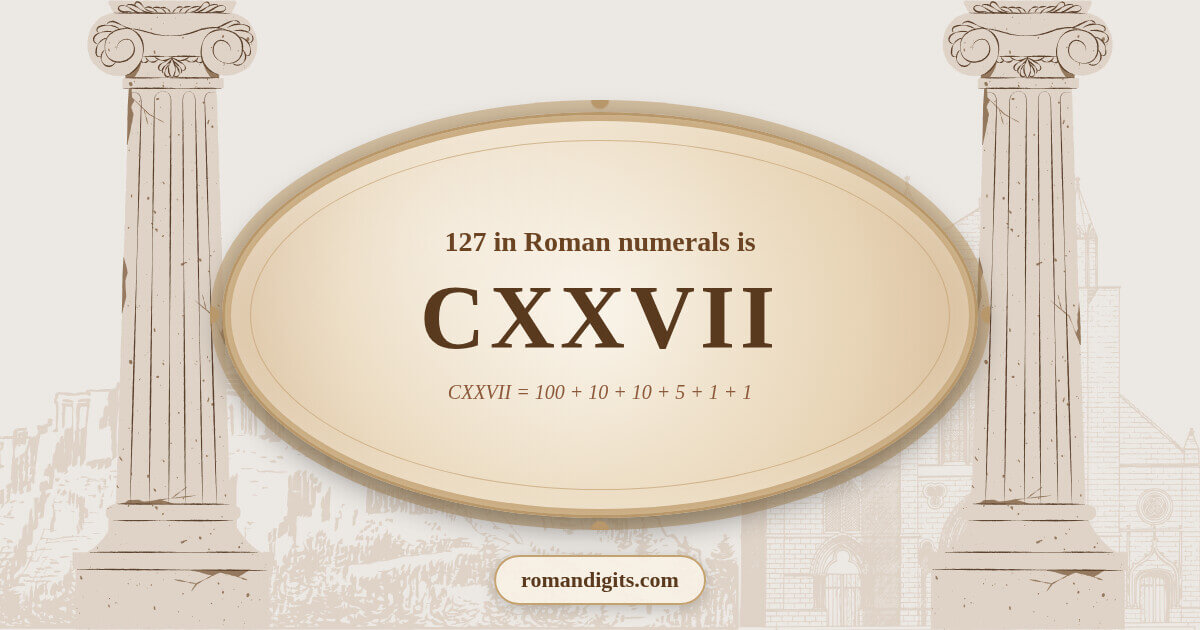
How to write 127 in Roman numerals: CXXVII = 100 + 20 + 7
How to Write 127 in Roman Numerals
To write 127 in Roman numerals, we combine C (100) with XX (20) and VII (7), where VII represents V (5) plus two I symbols.
The Roman numeral system represents 127 through straightforward addition: C (100) + XX (20) + VII (7) = CXXVII.
Breaking Down 127 (CXXVII)
Step-by-Step Breakdown
The number 127 demonstrates additive notation building on V (5), showing how two additional units (II) are added to create VII (7).
✅ Correct Representation
❌ Incorrect Representations
Historical Curiosity
The number 127 held mathematical significance even in ancient times as a prime number. Roman mathematicians recognized its indivisibility, making it important in certain calculations and administrative divisions where equal partitioning was not desired.
In Roman military contexts, 127 represented slight overstrength allocations. This prime number characteristic meant it could not be evenly divided into smaller equal units, which was sometimes strategically advantageous for maintaining unified command structures.
Evolution of 127 in Roman Numerals
The representation of 127 as CXXVII has remained consistent throughout history, demonstrating the stability of Roman notation.
| Period | Notation | Context |
|---|---|---|
| Ancient Rome (753 BC - 476 AD) | CXXVII | Administrative records and mathematical texts |
| Medieval Period (476 - 1453 AD) | CXXVII | Manuscript numbering and scholarly works |
| Modern Era (1453 - Present) | CXXVII | Formal numbering and computer science references |
Cultural Applications
- Extended chapter numbering in comprehensive works
- Architectural specification and plan numbering
- Legal code section references in detailed regulations
- Historical document and manuscript pagination
- Computer science contexts (maximum 7-bit signed integer value)
Decimal System Comparison
Comparing 127 in both number systems reveals different approaches to representing this special prime number.
- • Roman numerals: CXXVII = C + XX + VII = 100 + 20 + 7
- • Decimal system: 127 = (1 × 10²) + (2 × 10¹) + (7 × 10⁰)
- • Key difference: Roman uses symbol combination, decimal uses positional value
Number Progression
The number 127 continues the additive progression with VII:
| Arabic | Roman | Explanation |
|---|---|---|
| 125 | CXXV | C (100) + XX (20) + V (5) - base symbol |
| 126 | CXXVI | C (100) + XX (20) + VI (6) - one I added to V |
| 127 | CXXVII | C (100) + XX (20) + VII (7) - two I added to V |
| 128 | CXXVIII | C (100) + XX (20) + VIII (8) - three I added to V |
| 129 | CXXIX | C (100) + XX (20) + IX (9) - subtractive notation |
CXXVII shows the additive pattern continuing with VII, building toward the maximum repetition of I in VIII.
Additive Notation Rules
The number 127 demonstrates additive principles with proper symbol usage:
Rules Applied in CXXVII
- C (100) provides the foundation for numbers in the second century
- XX (20) properly doubles the symbol X for twenty
- VII (7) correctly adds two I symbols to the base symbol V
- All symbols follow descending order: C, XX, VII (largest to smallest)
Memory Tips
Strategies for remembering CXXVII (127):
Prime Number Significance
Remember that 127 is a Mersenne prime number: 2⁷ - 1 = 127. This makes it mathematically special and memorable.
In computer science, 127 is the maximum value for a 7-bit signed integer, making CXXVII particularly significant in digital contexts.
The sequence VI → VII → VIII shows the progression: 6, 7, 8. CXXVII fits in this pattern as CXXV + II.
In the Modern World
Computer Science
Maximum value for 7-bit signed integers in computing
Documentation
Extended sequential numbering in formal documents
Education
Teaching prime numbers and Roman numeral progression
Mathematical Properties of 127
The number 127 is a Mersenne prime, calculated as 2⁷ - 1. This makes it a particularly important number in mathematics and computer science. As a prime number, it can only be divided by 1 and itself. In computing, 127 is the maximum value that can be represented by a 7-bit signed integer, making it fundamental in digital systems.
Mathematical Properties of 127
The number 127 has several remarkable mathematical characteristics:
- Prime number (Mersenne prime: 2⁷ - 1 = 127)
- Only divisors are 1 and 127
- Maximum value for 7-bit signed integer in computing
- Double Mersenne prime (both 127 and the exponent 7 are prime)
- In binary: 1111111 (seven ones), in hexadecimal: 7F
Did You Know?
As a Mersenne prime, 127 has been known since ancient times. Mersenne primes are rare and have special properties that make them important in both pure mathematics and cryptography. The binary representation of 127 consists of seven consecutive 1s (1111111), making it a repunit in base 2.
Roman Numeral Pattern
The progression shows the additive pattern building with VII:
- CXXV (125) → CXXVI (126) → CXXVII (127) → CXXVIII (128) → CXXIX (129)
- CXXVII demonstrates adding two I symbols to V
- The pattern continues: VI, VII, VIII (approaching maximum I repetition)
Frequently Asked Questions
Why is 127 written as CXXVII?
127 is written as CXXVII because it combines C (100), XX (20), and VII (7). The VII represents 7 by adding two I symbols to V: V (5) + II (2) = VII (7). All components use additive notation: 100 + 20 + 7 = 127.
How do I remember CXXVII?
Think: C (one hundred) + XX (two tens) + VII (seven). Remember that 127 is a Mersenne prime (2⁷ - 1), which makes it mathematically special. You can also remember it as the maximum value for a 7-bit signed integer in computer science.
What does VII mean in Roman numerals?
VII means 7 in Roman numerals. It uses additive notation: V (5) + II (2) = 7. The two I symbols are placed after V, indicating addition. This pattern continues with VI (6), VII (7), and VIII (8).
Is CXXVII the only correct way to write 127?
Yes, CXXVII is the only standard correct form. Alternatives like CXXIIIIIII (repeating I seven times) would be incorrect because Roman numerals limit I to a maximum of three repetitions in sequence.
Where would I see 127 in Roman numerals?
CXXVII appears in extended chapter numbering, computer science documentation (as the maximum 7-bit value), legal code sections, manuscript pagination, and formal sequential numbering systems.
Why is 127 mathematically significant?
127 is a Mersenne prime (2⁷ - 1), making it special in number theory. It is also the largest value representable by a 7-bit signed integer in computing. In binary, 127 is written as 1111111 (seven consecutive ones), giving it unique properties in digital systems.
Summary
Key Points About CXXVII
- CXXVII represents 127 using pure additive notation
- Combines C (100) + XX (20) + VII (7)
- VII demonstrates adding two I symbols to base symbol V
- Follows descending order: largest to smallest symbols
Modern Usage
- Computer science (maximum 7-bit signed integer)
- Extended chapter and section numbering
- Educational materials for prime numbers
- Legal and administrative document numbering
The Roman numeral CXXVII (127) demonstrates straightforward additive notation while representing a mathematically significant prime number. As a Mersenne prime (2⁷ - 1) and the maximum 7-bit signed integer value, 127 bridges classical Roman notation with modern computing, making it an excellent example of how ancient numbering systems continue to have relevance in contemporary contexts.
Converting number 127 to Roman
This is the number 127 written in Roman numerals
Try the Roman numeral converter
Want to convert other numbers? Use our converter: