
125 in Roman Numerals is CXXV
The Roman numeral for 125 is CXXV. This number demonstrates pure additive notation, combining C (100), XX (20), and V (5) without any subtractive elements.
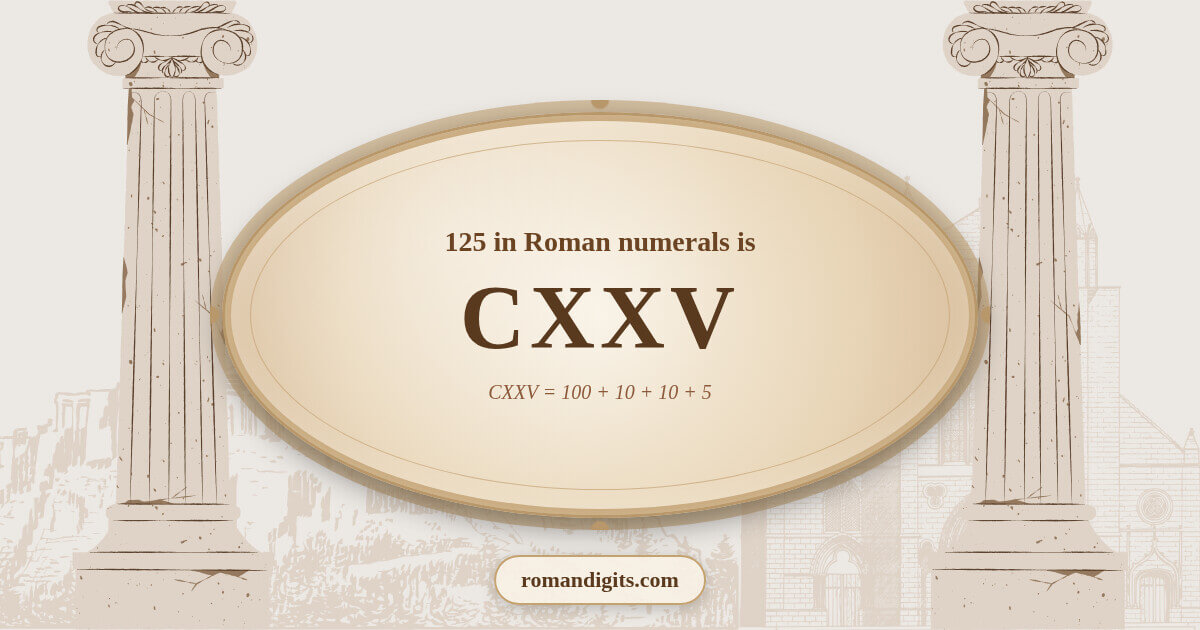
How to write 125 in Roman numerals: CXXV = 100 + 20 + 5
How to Write 125 in Roman Numerals
To write 125 in Roman numerals, we combine C (100) with XX (20) and V (5), using pure additive notation throughout.
The Roman numeral system represents 125 by combining three basic components: C (100) + XX (20) + V (5) = CXXV.
Breaking Down 125 (CXXV)
Step-by-Step Breakdown
The number 125 exemplifies straightforward additive notation, where all components are simply added together without any subtractive elements.
✅ Correct Representation
❌ Incorrect Representations
Historical Curiosity
The number 125 held special significance in Roman commerce and measurement systems. Roman pounds (librae) were divided into 12 ounces (unciae), and calculations involving fractional weights often used 125 as a reference point in commercial transactions.
In Roman military logistics, 125 represented an important threshold for supply calculations. Legion quartermasters used this number in provisions planning, as it represented slightly more than a standard centuria, allowing for strategic reserve allocations.
Evolution of 125 in Roman Numerals
The representation of 125 as CXXV has remained remarkably consistent throughout history, demonstrating the stability of additive notation.
| Period | Notation | Context |
|---|---|---|
| Ancient Rome (753 BC - 476 AD) | CXXV | Commerce, military logistics, and measurement systems |
| Medieval Period (476 - 1453 AD) | CXXV | Manuscript pagination and ecclesiastical records |
| Modern Era (1453 - Present) | CXXV | Formal numbering and educational materials |
Cultural Applications
- Academic chapter numbering in extended works
- Architectural specification sequences
- Legal code section references
- Historical document and manuscript page numbering
- Sequential numbering in formal administrative systems
Decimal System Comparison
The number 125 demonstrates fundamental differences between positional and additive number systems.
- • Roman numerals: CXXV = C + XX + V = 100 + 20 + 5
- • Decimal system: 125 = (1 × 10²) + (2 × 10¹) + (5 × 10⁰)
- • Key difference: Roman uses symbol combination, decimal uses position value
Number Progression
The number 125 follows the natural progression after the subtractive notation at 124:
| Arabic | Roman | Explanation |
|---|---|---|
| 123 | CXXIII | C (100) + XX (20) + III (3) - three units |
| 124 | CXXIV | C (100) + XX (20) + IV (4) - subtractive notation |
| 125 | CXXV | C (100) + XX (20) + V (5) - return to additive |
| 126 | CXXVI | C (100) + XX (20) + VI (6) - additive continues |
| 127 | CXXVII | C (100) + XX (20) + VII (7) - additive pattern |
CXXV represents the return to straightforward additive notation after the subtractive IV used in 124.
Additive Notation Rules
The number 125 demonstrates the principles of additive notation without subtractive elements:
Rules Applied in CXXV
- C (100) establishes the foundation for the second century
- XX (20) correctly doubles the X symbol for twenty
- V (5) is a base symbol that cannot be repeated
- All symbols follow descending order: C, XX, V (largest to smallest)
Memory Tips
Strategies for remembering CXXV (125):
Simple Additive Pattern
Remember that 125 follows a clean additive pattern: one hundred (C) plus two tens (XX) plus five (V). There is no subtractive notation to worry about.
Think of 125 as a mathematical milestone: 5³ (five cubed). This makes CXXV particularly memorable as it represents the third power of five.
Practice the sequence: CXXIII (123) → CXXIV (124) → CXXV (125) → CXXVI (126) to understand how Roman numerals transition from subtractive IV back to additive notation starting with V.
In the Modern World
Architecture
Building specifications and room numbering systems
Documentation
Extended chapter and section numbering
Education
Teaching additive notation principles
Mathematical Properties of 125
The number 125 is mathematically significant as 5³ (five cubed), making it a perfect cube. This property made 125 important in volumetric calculations throughout history. It is an odd composite number with prime factorization consisting entirely of one prime: 5 × 5 × 5.
Mathematical Properties of 125
The number 125 has several remarkable mathematical characteristics:
- Perfect cube: 125 = 5³ (5 × 5 × 5)
- Odd composite number with prime factorization 5³
- Deficient number (sum of proper divisors: 1 + 5 + 25 = 31 < 125)
- Has exactly 4 divisors: 1, 5, 25, 125
- In binary: 1111101, in hexadecimal: 7D
Did You Know?
125 is the smallest number that can be expressed as the sum of two perfect squares in two different ways: 125 = 2² + 11² = 5² + 10². This property makes it mathematically interesting and was recognized by ancient mathematicians.
Roman Numeral Pattern
The progression shows the return to additive notation after subtractive IV:
- CXXIII (123) → CXXIV (124) → CXXV (125) → CXXVI (126) → CXXVII (127)
- CXXV marks the return to simple additive notation with V (5)
- From this point, numerals build upward: VI, VII, VIII until reaching IX
Frequently Asked Questions
Why is 125 written as CXXV?
125 is written as CXXV because it combines C (100), XX (20), and V (5) using additive notation. All three components are simply added together: 100 + 20 + 5 = 125. There is no subtractive notation needed for this number.
How do I remember CXXV?
Think: C (one hundred) + XX (two tens) + V (five). An easy way to remember is that 125 equals 5³ (five cubed), which makes it mathematically special. The Roman notation CXXV follows the straightforward pattern of adding components from largest to smallest.
What is the difference between CXXIV (124) and CXXV (125)?
CXXIV uses subtractive notation IV for the number 4, while CXXV uses the simple symbol V for 5. This shows the transition from subtractive notation back to additive notation when reaching the base value V.
Is CXXV the only correct way to write 125?
Yes, CXXV is the only standard correct form. Other variations like VIIXX or CXXIIIII would be incorrect because they violate Roman numeral rules about symbol order and repetition limits.
Where would I see 125 in Roman numerals?
CXXV appears in extended chapter numbering, architectural specifications, legal code sections, historical document pagination, and formal sequential numbering systems that require numbers beyond 100.
Why is 125 mathematically significant?
125 is the cube of 5 (5³ = 5 × 5 × 5 = 125), making it a perfect cube. This property gave it special significance in ancient volumetric calculations and geometric studies. It remains an important number in mathematics education today.
Summary
Key Points About CXXV
- CXXV represents 125 using pure additive notation
- Combines C (100) + XX (20) + V (5) without subtractive elements
- Follows descending order rule: largest to smallest symbols
- Demonstrates the return to additive pattern after IV at 124
Modern Usage
- Extended chapter and section numbering
- Architectural specifications and building plans
- Educational materials demonstrating notation principles
- Legal and administrative document numbering
The Roman numeral CXXV (125) exemplifies straightforward additive notation, combining three basic Roman symbols in descending order. As a perfect cube (5³), the number 125 holds mathematical significance that extends beyond its Roman representation, making it an excellent example for understanding how Roman numerals express quantities through symbol combination.
Converting number 125 to Roman
This is the number 125 written in Roman numerals
Try the Roman numeral converter
Want to convert other numbers? Use our converter: