
126 in Roman Numerals is CXXVI
The Roman numeral for 126 is CXXVI. This number combines C (100), XX (20), and VI (6) using pure additive notation, building upon the base symbol V (5) by adding one I.
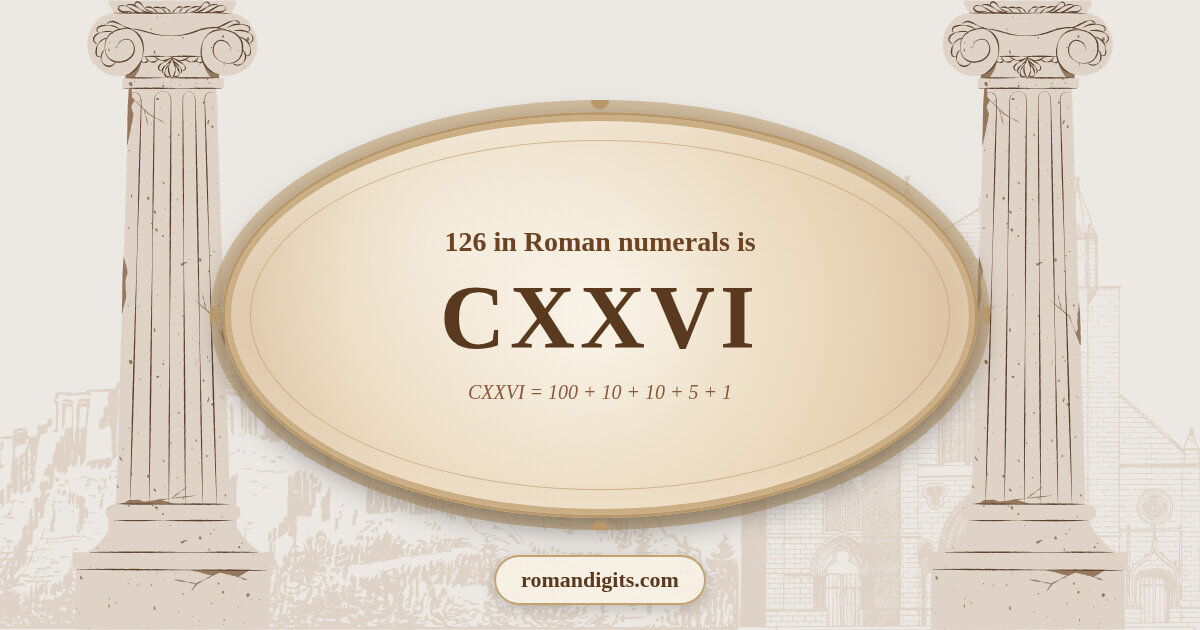
How to write 126 in Roman numerals: CXXVI = 100 + 20 + 6
How to Write 126 in Roman Numerals
To write 126 in Roman numerals, we combine C (100) with XX (20) and VI (6), where VI represents V (5) plus I (1).
The Roman numeral system represents 126 through straightforward addition: C (100) + XX (20) + VI (6) = CXXVI.
Breaking Down 126 (CXXVI)
Step-by-Step Breakdown
The number 126 demonstrates additive notation building on the symbol V (5), showing how additional units are added using I.
✅ Correct Representation
❌ Incorrect Representations
Historical Curiosity
The number 126 appeared frequently in Roman architectural calculations. As a triangular number (the sum of all integers from 1 to 18), it held special significance in geometric designs and spatial planning used by Roman architects and engineers.
In Roman military organization, 126 represented strategic groupings for combined operations. This number, just over a standard centuria, allowed commanders to organize reinforced units while maintaining traditional command structures.
Evolution of 126 in Roman Numerals
The representation of 126 as CXXVI has remained consistent across centuries, demonstrating the reliability of additive notation.
| Period | Notation | Context |
|---|---|---|
| Ancient Rome (753 BC - 476 AD) | CXXVI | Architectural measurements and military records |
| Medieval Period (476 - 1453 AD) | CXXVI | Manuscript numbering and mathematical texts |
| Modern Era (1453 - Present) | CXXVI | Formal sequential numbering systems |
Cultural Applications
- Extended chapter numbering in scholarly volumes
- Architectural drawing and specification sequences
- Legal statute and regulation numbering
- Historical manuscript page references
- Academic and administrative record numbering
Decimal System Comparison
Comparing 126 in both number systems reveals different approaches to representing quantities.
- • Roman numerals: CXXVI = C + XX + VI = 100 + 20 + 6
- • Decimal system: 126 = (1 × 10²) + (2 × 10¹) + (6 × 10⁰)
- • Key difference: Roman combines symbols, decimal uses positional value
Number Progression
The number 126 continues the additive progression after V (5):
| Arabic | Roman | Explanation |
|---|---|---|
| 124 | CXXIV | C (100) + XX (20) + IV (4) - subtractive notation |
| 125 | CXXV | C (100) + XX (20) + V (5) - base symbol |
| 126 | CXXVI | C (100) + XX (20) + VI (6) - adding I to V |
| 127 | CXXVII | C (100) + XX (20) + VII (7) - continuing addition |
| 128 | CXXVIII | C (100) + XX (20) + VIII (8) - maximum I repetition |
CXXVI shows the additive pattern building from the base symbol V by adding individual I symbols.
Additive Notation Rules
The number 126 demonstrates additive principles with proper symbol usage:
Rules Applied in CXXVI
- C (100) provides the foundation for numbers in the second century
- XX (20) properly doubles the symbol X for twenty
- VI (6) correctly adds I to the base symbol V
- All symbols follow descending order: C, XX, VI (largest to smallest)
Memory Tips
Strategies for remembering CXXVI (126):
Building from V
Remember that 126 builds on V (5): start with CXXV (125) and add one I to get CXXVI (126). This pattern continues through VII (7) and VIII (8).
Think of 126 as a triangular number: the sum of all numbers from 1 to 18. This mathematical property makes it memorable in geometric contexts.
The sequence CXXV → CXXVI → CXXVII shows the simple additive pattern: V, VI, VII.
In the Modern World
Architecture
Building plans and measurement specifications
Documentation
Extended sequential numbering in formal documents
Education
Teaching number progression and additive principles
Mathematical Properties of 126
The number 126 is a triangular number, representing the sum of all integers from 1 to 18: 1 + 2 + 3 + ... + 17 + 18 = 126. This property made it significant in geometric calculations and spatial arrangements. It is also an abundant number, where the sum of its proper divisors exceeds the number itself.
Mathematical Properties of 126
The number 126 has several interesting mathematical characteristics:
- Triangular number: 126 = 1 + 2 + 3 + ... + 17 + 18
- Composite number with prime factorization 2 × 3² × 7
- Abundant number (sum of proper divisors: 186 > 126)
- Has 12 divisors: 1, 2, 3, 6, 7, 9, 14, 18, 21, 42, 63, 126
- In binary: 1111110, in hexadecimal: 7E
Did You Know?
As a triangular number, 126 dots can be arranged in an equilateral triangle with 18 dots on each side. This geometric property was recognized by ancient mathematicians and used in architectural and artistic designs.
Roman Numeral Pattern
The progression shows the additive pattern building from V:
- CXXIV (124) → CXXV (125) → CXXVI (126) → CXXVII (127) → CXXVIII (128)
- CXXVI demonstrates adding I to the base symbol V
- The pattern continues: VI (6), VII (7), VIII (8) until reaching IX (9)
Frequently Asked Questions
Why is 126 written as CXXVI?
126 is written as CXXVI because it combines C (100), XX (20), and VI (6). The VI represents 6 by adding I to the base symbol V: V (5) + I (1) = VI (6). All components use additive notation: 100 + 20 + 6 = 126.
How do I remember CXXVI?
Think: C (one hundred) + XX (two tens) + VI (six). Remember that VI is simply V (5) plus one I (1). You can also remember that 126 is a triangular number, the sum of all numbers from 1 to 18, which makes it mathematically special.
What does VI mean in Roman numerals?
VI means 6 in Roman numerals. It uses additive notation: V (5) + I (1) = 6. The smaller symbol I is placed after the larger symbol V, indicating addition rather than subtraction.
Is CXXVI the only correct way to write 126?
Yes, CXXVI is the only standard correct form. Alternatives like CXXIIIIII (repeating I six times) would be incorrect because Roman numerals limit I to a maximum of three repetitions.
Where would I see 126 in Roman numerals?
CXXVI appears in extended chapter numbering, architectural specifications, legal code sections, manuscript pagination, and formal sequential numbering systems that extend beyond 100.
Why is 126 mathematically significant?
126 is a triangular number, meaning it equals the sum of consecutive integers from 1 to 18. This geometric property made it important in ancient mathematics and architectural design, where triangular arrangements were common.
Summary
Key Points About CXXVI
- CXXVI represents 126 using pure additive notation
- Combines C (100) + XX (20) + VI (6)
- VI demonstrates adding I to the base symbol V
- Follows descending order: largest to smallest symbols
Modern Usage
- Extended chapter and section numbering
- Architectural specifications and plans
- Educational materials for Roman numeral progression
- Legal and administrative document numbering
The Roman numeral CXXVI (126) demonstrates straightforward additive notation, building from the base symbol V by adding I to create VI (6). As a triangular number with special geometric properties, 126 holds mathematical significance that extends beyond its Roman representation, making it an excellent example of how Roman numerals express quantities through systematic symbol combination.
Converting number 126 to Roman
This is the number 126 written in Roman numerals
Try the Roman numeral converter
Want to convert other numbers? Use our converter: