
123 in Roman Numerals is CXXIII
The Roman numeral for 123 is CXXIII. This number demonstrates classic additive notation, combining C (100) with XX (20) and III (3) to create one hundred twenty-three.
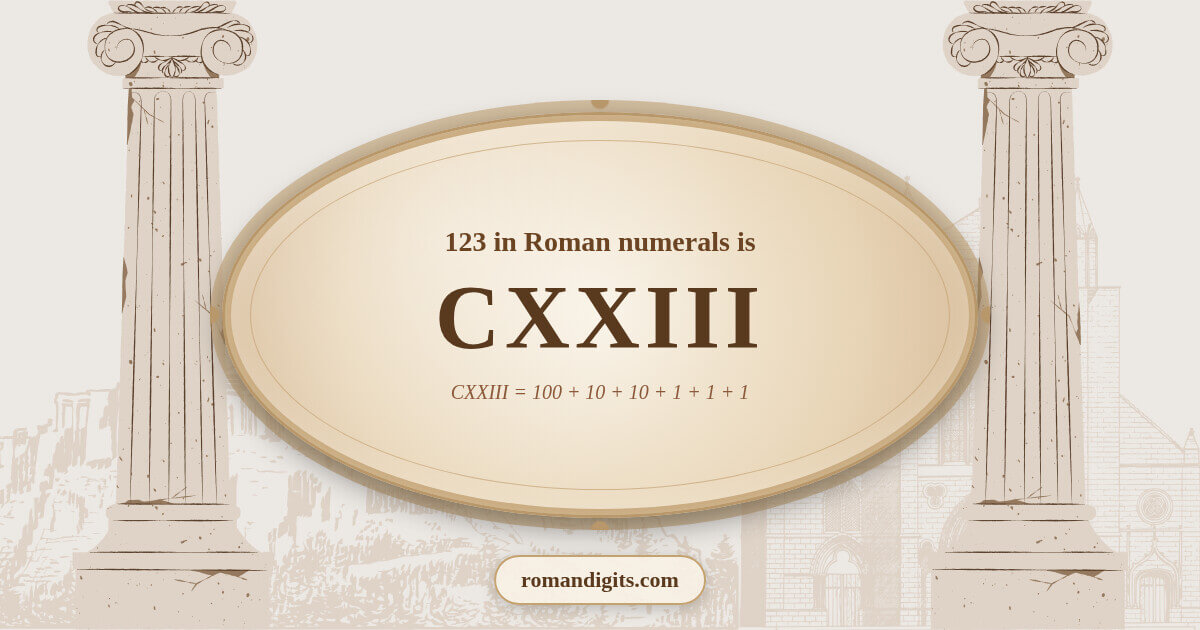
How to write 123 in Roman numerals: CXXIII = 100 + 20 + 3
How to Write 123 in Roman Numerals
To write 123 in Roman numerals, we combine C (100) with XX (20) and III (3) using pure additive notation.
The Roman numeral system represents 123 by adding three components: C (100) + XX (20) + III (3) = CXXIII.
Breaking Down 123 (CXXIII)
Step-by-Step Breakdown
The number 123 demonstrates proper Roman numeral construction using additive notation with the maximum repetition of I (three times).
✅ Correct Representation
❌ Incorrect Representations
Historical Curiosity
The number 123 appeared in Roman taxation records and trade manifests, representing quantities of goods, coins, or commodities in commercial transactions throughout the empire.
Roman surveyors used measurements involving 123 paces (approximately 180 meters) in land division and boundary marking, particularly when subdividing agricultural plots around expanding cities.
Evolution of 123 in Roman Numerals
The representation of 123 as CXXIII has remained consistent throughout history.
| Period | Notation | Context |
|---|---|---|
| Ancient Rome (753 BC - 476 AD) | CXXIII | Trade records and land surveying |
| Medieval Period (476 - 1453 AD) | CXXIII | Manuscript chapters and legal codes |
| Modern Era (1453 - Present) | CXXIII | Formal sequential numbering |
Cultural Applications
- Extended academic thesis chapter and section organization
- Legal code article and clause sequential numbering
- Architectural project specification numbering
- Historical manuscript folio and page references
- Formal documentation in governmental records
Decimal System Comparison
The number 123 is often used as a simple sequential example in both systems.
- • Roman numerals: CXXIII = C + XX + III = 100 + 20 + 3
- • Decimal system: 123 = (1 × 100) + (2 × 10) + (3 × 1)
- • Sequential pattern: Both systems show clear progression 1-2-3
Number Progression Around 123
Understanding the sequence around 123 shows the natural flow of Roman numerals:
| Arabic | Roman | Explanation |
|---|---|---|
| 121 | CXXI | C (100) + XX (20) + I (1) = 121 |
| 122 | CXXII | C (100) + XX (20) + II (2) = 122 |
| 123 | CXXIII | C (100) + XX (20) + III (3) = 123 |
| 124 | CXXIV | C (100) + XX (20) + IV (4) = 124 |
| 125 | CXXV | C (100) + XX (20) + V (5) = 125 |
CXXIII demonstrates the maximum repetition of I (three times) before switching to subtractive notation IV at 124.
Symbol Repetition Rules
The number 123 shows important repetition principles in Roman numerals:
Rules Applied in CXXIII
- C (100) serves as the foundation for second century numbers
- XX (20) properly repeats X twice for two tens
- III (3) properly repeats I three times - the maximum allowed
- Symbols maintain strict descending value order
Memory Tips
Strategies for remembering CXXIII (123):
Sequential Pattern Recognition
Remember 123 as "one-two-three" - the simplest counting sequence. In Roman numerals, it becomes C (one hundred) + XX (two tens) + III (three ones).
Notice that CXXIII uses the maximum repetition of I allowed in Roman numerals (three times). After 123, the next number switches to IV for 4.
Practice sequence: CXXI (121) → CXXII (122) → CXXIII (123) → CXXIV (124)
In the Modern World
Education
Teaching basic sequential counting patterns
Documentation
Sequential section and chapter numbering
Legal
Legal code and statute numbering
Mathematical and Cultural Significance
The number 123 is widely recognized as the simplest ascending sequential pattern (1-2-3), making it culturally significant as a symbol of basic counting and progression. In mathematics, 123 is a Lucas number, part of a sequence similar to Fibonacci numbers. It equals the sum of three consecutive numbers: 40 + 41 + 42 = 123.
Mathematical Properties of 123
The number 123 has several notable mathematical characteristics:
- Composite number with prime factorization 3 × 41
- Deficient number (sum of divisors: 1 + 3 + 41 = 45 < 123)
- Sum of consecutive integers: 40 + 41 + 42 = 123
- Has 4 divisors: 1, 3, 41, 123
- In binary: 1111011, in hexadecimal: 7B
Did You Know?
123 is universally recognized as the simplest sequential number pattern, often used as a default example in mathematics, programming, and education. The phrase "easy as 1-2-3" reflects this number's cultural significance as representing simplicity and natural order.
Roman Numeral Pattern
The progression demonstrates the natural flow of Roman numeral construction:
- CXXI (121) → CXXII (122) → CXXIII (123) → CXXIV (124) → CXXV (125)
- CXXIII shows the maximum repetition of I (three times)
- After 123, the pattern shifts to IV (subtractive notation) for 4
Frequently Asked Questions
Why is 123 written as CXXIII?
CXXIII represents 123 through additive notation: C (100) + XX (20) + III (3) = 123. The III represents 3 by repeating I three times, which is the maximum allowed repetition for I in Roman numerals.
Why does 123 use III but 124 uses IV?
Roman numerals allow I to be repeated a maximum of three times. For 123, we use III (three Is). For 124, we cannot use IIII, so we switch to subtractive notation IV (5 - 1 = 4) and add it: CXX + IV = CXXIV.
How do I remember CXXIII?
Think of the simple "1-2-3" pattern: C is one hundred, XX is two tens, III is three ones. The number 123 itself helps you remember its Roman form through this sequential pattern.
Is CXXIII ever written differently?
No, CXXIII is the only correct standard way to write 123. The symbols must be in descending value order: C, then XX, then III.
What makes 123 special?
123 is the simplest ascending sequential number (1-2-3), making it culturally significant as a symbol of basic counting. It appears frequently in examples, tutorials, and educational materials across many fields.
Where would we see 123 in Roman numerals today?
CXXIII appears in extended chapter numbering, legal code sections, architectural specifications, and any formal sequential numbering system that extends into the second century of numbers.
Summary
Key Points About CXXIII
- CXXIII represents 123 using pure additive notation
- Demonstrates maximum repetition of I (three times)
- Combines C (100) + XX (20) + III (3) in descending order
- Shows the transition point before subtractive notation at 124
Modern Usage
- Educational examples and sequential pattern teaching
- Extended chapter and section numbering systems
- Legal code and statute article numbering
- Formal documentation and governmental records
The Roman numeral CXXIII (123) represents both a simple sequential pattern and an important demonstration of Roman numeral repetition rules. As the last number before the switch to subtractive notation for the units digit, it showcases the maximum allowed repetition of I while maintaining the clear, additive logic of Roman numeral construction.
Converting number 123 to Roman
This is the number 123 written in Roman numerals
Try the Roman numeral converter
Want to convert other numbers? Use our converter: