
122 in Roman Numerals is CXXII
The Roman numeral for 122 is CXXII. This number demonstrates straightforward additive notation, combining C (100) with XX (20) and II (2) to create one hundred twenty-two.
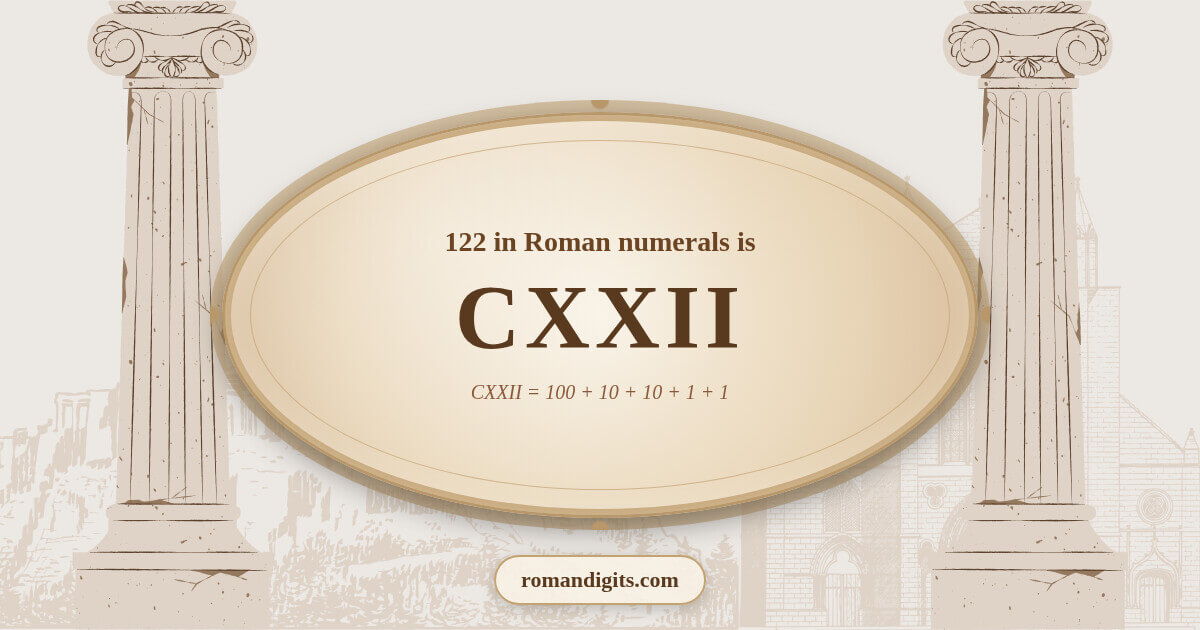
How to write 122 in Roman numerals: CXXII = 100 + 20 + 2
How to Write 122 in Roman Numerals
To write 122 in Roman numerals, we combine C (100) with XX (20) and II (2) using pure additive notation.
The Roman numeral system represents 122 by adding three components: C (100) + XX (20) + II (2) = CXXII.
Breaking Down 122 (CXXII)
Step-by-Step Breakdown
The number 122 demonstrates efficient Roman numeral construction using pure additive notation with proper symbol repetition.
✅ Correct Representation
❌ Incorrect Representations
Historical Curiosity
The number 122 appeared frequently in Roman administrative documents, representing quantities slightly above the standard centuria unit in military and civic organization.
Roman builders and surveyors used measurements of 122 Roman feet in construction projects, as this distance worked well for spacing columns in medium-sized public buildings and forums.
Evolution of 122 in Roman Numerals
The representation of 122 as CXXII has remained consistent throughout history.
| Period | Notation | Context |
|---|---|---|
| Ancient Rome (753 BC - 476 AD) | CXXII | Administrative records and construction |
| Medieval Period (476 - 1453 AD) | CXXII | Manuscript pagination and legal texts |
| Modern Era (1453 - Present) | CXXII | Formal numbering systems |
Cultural Applications
- Academic chapter and section numbering in extended works
- Legal document clause references in comprehensive codes
- Architectural measurements and building specifications
- Historical manuscript page numbering systems
- Sequential numbering in formal documentation
Decimal System Comparison
The number 122 shows clear parallels between Roman and decimal notation.
- • Roman numerals: CXXII = C + XX + II = 100 + 20 + 2
- • Decimal system: 122 = (1 × 100) + (2 × 10) + (2 × 1)
- • Both systems use positional value and addition
Number Progression Around 122
Understanding the sequence around 122 demonstrates systematic Roman numeral construction:
| Arabic | Roman | Explanation |
|---|---|---|
| 120 | CXX | C (100) + XX (20) = 120 |
| 121 | CXXI | C (100) + XX (20) + I (1) = 121 |
| 122 | CXXII | C (100) + XX (20) + II (2) = 122 |
| 123 | CXXIII | C (100) + XX (20) + III (3) = 123 |
| 124 | CXXIV | C (100) + XX (20) + IV (4) = 124 |
CXXII follows the predictable pattern of building upon C and XX as the foundation.
Additive Construction Rules
The number 122 demonstrates pure additive Roman numeral construction:
Rules Applied in CXXII
- C (100) serves as the base for the second century
- XX (20) uses proper symbol repetition for two tens
- II (2) uses proper symbol repetition for two units
- All symbols arranged in descending value order
Memory Tips
Strategies for remembering CXXII (122):
Building Block Method
Think of CXXII as simple building blocks: C (one hundred) + XX (two tens) + II (two ones).
Notice the pattern of twos: 122 has two 2s in decimal, and CXXII has two Xs and two Is in Roman numerals.
Practice: CXX (120) → CXXI (121) → CXXII (122) → CXXIII (123)
In the Modern World
Documentation
Extended chapter and section numbering
Architecture
Building measurements and specifications
Legal
Legal code clause numbering
Mathematical Properties of 122
The number 122 is an even composite number with the prime factorization 2 × 61. It is the sum of four consecutive prime numbers: 23 + 29 + 31 + 37 = 120, plus 2. In mathematics, 122 is classified as a deficient number, meaning the sum of its proper divisors (1, 2, 61) totaling 64 is less than the number itself.
Mathematical Properties of 122
The number 122 has several interesting mathematical characteristics:
- Composite number with prime factorization 2 × 61
- Deficient number (sum of divisors: 1 + 2 + 61 = 64 < 122)
- Even number divisible by 2 and 61
- Has 4 divisors: 1, 2, 61, 122
- In binary: 1111010, in hexadecimal: 7A
Did You Know?
122 is the smallest number that can be expressed as the sum of four consecutive primes plus 2: (23 + 29 + 31 + 37) + 2 = 122. This makes it interesting in additive number theory.
Roman Numeral Pattern
The progression shows systematic construction in the 120s:
- CXX (120) → CXXI (121) → CXXII (122) → CXXIII (123) → CXXIV (124)
- Each number builds upon C (100) and XX (20) with systematic unit additions
- The pattern shows clear additive logic in Roman numeral construction
Frequently Asked Questions
Why is 122 written as CXXII?
CXXII represents 122 through pure additive notation: C (100) + XX (20) + II (2) = 122. This follows the Roman numeral principle of arranging symbols in descending value order.
How do I remember CXXII?
Think of building blocks: C (one hundred) + XX (two tens) + II (two ones). Notice that 122 has two 2s in decimal, and CXXII has two Xs and two Is in Roman notation.
Can CXXII be written differently?
No, CXXII is the standard and only correct way to write 122 in Roman numerals. The symbols must be in descending value order: C, then XX, then II.
What is the difference between CXXI and CXXII?
CXXI represents 121 (100 + 20 + 1) while CXXII represents 122 (100 + 20 + 2). The difference is one I symbol, representing the unit difference between consecutive numbers.
Where would we see 122 in Roman numerals today?
You might encounter CXXII in extended chapter numbering in academic works, legal document clause references, building specifications, or formal sequential numbering systems.
Is there any pattern to remember numbers in the 120s?
Yes, all numbers from 120-129 start with CXX (120 as the base), then add the units digits: CXXI (121), CXXII (122), CXXIII (123), CXXIV (124), and so on.
Summary
Key Points About CXXII
- CXXII represents 122 using pure additive notation
- Combines C (100) + XX (20) + II (2) in descending order
- Demonstrates proper symbol repetition rules
- Follows systematic Roman numeral construction
Modern Usage
- Extended chapter and section numbering
- Architectural building specifications
- Legal document clause references
- Formal sequential numbering systems
The Roman numeral CXXII (122) exemplifies the clarity and systematic nature of additive notation. By combining C, XX, and II in descending order, it demonstrates how Roman numerals efficiently represent numbers through straightforward addition of symbol values.
Converting number 122 to Roman
This is the number 122 written in Roman numerals
Try the Roman numeral converter
Want to convert other numbers? Use our converter: