
121 in Roman Numerals is CXXI
The Roman numeral for 121 is CXXI. This number represents the perfect square of eleven (11²) and demonstrates straightforward additive notation combining C (100) with XX (20) and I (1).
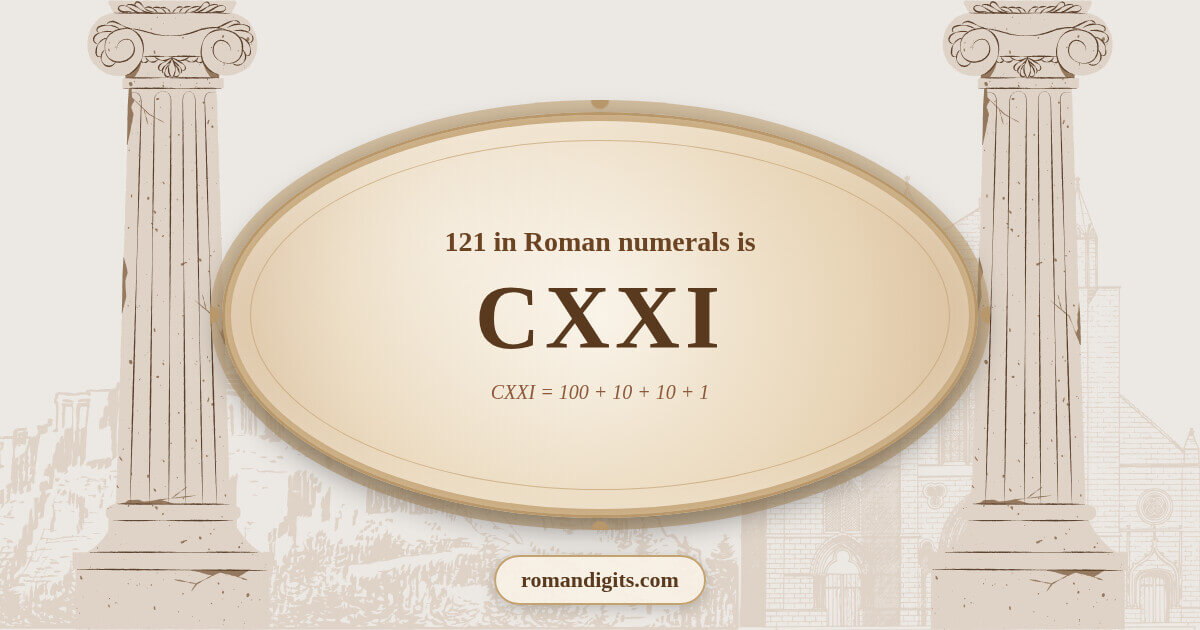
How to write 121 in Roman numerals: CXXI = 100 + 20 + 1
How to Write 121 in Roman Numerals
To write 121 in Roman numerals, we combine C (100) with XX (20) and I (1) using pure additive notation.
The Roman numeral system represents 121 by adding three components together: C (100) + XX (20) + I (1) = CXXI.
Breaking Down 121 (CXXI)
Step-by-Step Breakdown
The number 121 demonstrates clean Roman numeral construction using pure addition without any subtractive notation, making it straightforward to read and write.
✅ Correct Representation
❌ Incorrect Representations
Historical Curiosity
The number 121 held special significance in Roman mathematics as the square of eleven. Roman mathematicians recognized square numbers and used them in architectural planning and land surveying.
In Roman military organization, units of approximately 121 soldiers appeared in specialized formations. The number was practical for arranging troops in square formations of eleven by eleven, which provided tactical advantages in certain combat situations.
Evolution of 121 in Roman Numerals
The representation of 121 as CXXI has remained consistent throughout history, demonstrating the stability of Roman numeral additive notation.
| Period | Notation | Context |
|---|---|---|
| Ancient Rome (753 BC - 476 AD) | CXXI | Military records and mathematical computations |
| Medieval Period (476 - 1453 AD) | CXXI | Manuscript numbering and mathematical texts |
| Modern Era (1453 - Present) | CXXI | Mathematical notation and formal numbering |
Cultural Applications
- Mathematical texts discussing perfect squares and prime relationships
- Architectural designs using square formations and symmetrical patterns
- Historical documents referencing military unit sizes and organization
- Legal texts using systematic clause and section numbering
- Academic papers exploring number theory and mathematical properties
Decimal System Comparison
The number 121 demonstrates both Roman and decimal system approaches to representing perfect squares.
- • Roman numerals: CXXI = C + XX + I = 100 + 20 + 1 = 121
- • Decimal system: 121 = (1 × 100) + (2 × 10) + (1 × 1)
- • Mathematical property: 121 = 11² (perfect square)
- • Prime factorization: 11 × 11
Number Progression Around 121
Understanding the sequence around 121 shows the systematic progression in the second century:
| Arabic | Roman | Explanation |
|---|---|---|
| 119 | CXIX | C (100) + X (10) + IX (9) = 119 |
| 120 | CXX | C (100) + XX (20) = 120 |
| 121 | CXXI | C (100) + XX (20) + I (1) = 121 |
| 122 | CXXII | C (100) + XX (20) + II (2) = 122 |
| 130 | CXXX | C (100) + XXX (30) = 130 |
The number 121 fits naturally into the Roman numeral progression, building upon the foundation of C (100) with logical additions.
Additive Construction Rules
The number 121 demonstrates straightforward Roman numeral building using pure addition:
Rules Applied in CXXI
- C (100) serves as the base for the second century
- XX (20) follows proper symbol repetition (two tens)
- I (1) is added after the larger values
- All symbols arranged in strict descending value order
Memory Tips
Strategies for remembering CXXI (121):
Perfect Square Recognition
Remember that 121 is 11 squared (11²), making it a perfect square. This mathematical property helps anchor the number in memory.
Think of CXXI as building blocks: C (century) + XX (two tens) + I (one unit). The pattern is logical and predictable.
Practice the sequence: CXX (120) → CXXI (121) → CXXII (122) to understand the natural progression.
In the Modern World
Mathematics
Perfect square studies and number theory research
Gaming
Game level numbering and achievement systems
Architecture
Building measurements and square pattern designs
Mathematical Significance of 121
The number 121 is particularly notable as the square of eleven (11²), making it a perfect square. It is also the sum of three consecutive prime numbers: 37 + 41 + 43 = 121. In number theory, 121 is classified as a palindrome in decimal notation, reading the same forwards and backwards. The number has exactly three divisors (1, 11, 121), characteristic of perfect squares of prime numbers.
Mathematical Properties of 121
The number 121 possesses several fascinating mathematical characteristics:
- 121 = 11² (perfect square of the prime number 11)
- Sum of consecutive primes: 37 + 41 + 43 = 121
- Palindrome in decimal: reads the same forwards and backwards
- Has exactly three divisors: 1, 11, and 121
- In binary: 1111001, in hexadecimal: 79
Did You Know?
121 is unique as both a perfect square and a palindrome. It is the smallest non-trivial palindromic square number. This dual property makes it particularly interesting in recreational mathematics and number theory studies.
Roman Numeral Pattern
The progression shows systematic construction in the 120s:
- CXX (120) → CXXI (121) → CXXII (122) → CXXIII (123)
- Each number builds upon C (100) as the foundation with systematic additions
- The pattern demonstrates Roman numeral consistency and logical structure
Frequently Asked Questions
Why is 121 written as CXXI?
CXXI represents 121 through additive notation: C (100) + XX (20) + I (1) = 121. This follows the Roman numeral principle of arranging symbols in descending order of value and adding their values together.
What makes 121 mathematically special?
121 is the perfect square of 11 (11²), making it significant in mathematics. It is also a palindrome number, reading the same forwards and backwards (1-2-1), and can be expressed as the sum of three consecutive prime numbers: 37 + 41 + 43 = 121.
How do I remember that 121 is CXXI?
Think of it as building blocks: C (one hundred) + XX (two tens) + I (one unit) = CXXI. Remembering that 121 is 11 squared can also help, as it creates a memorable mathematical anchor for the number.
Can CXXI be written differently?
No, CXXI is the standard and only correct way to write 121 in Roman numerals. Any other arrangement would either represent a different number or violate Roman numeral rules about symbol ordering and placement.
Where do we see 121 in the modern world?
The number 121 appears in mathematical contexts when studying perfect squares, in game level systems, in building measurements that use square patterns, and in various academic and technical documentation requiring systematic numbering.
What is the difference between CXX and CXXI?
CXX represents 120 (100 + 20) while CXXI represents 121 (100 + 20 + 1). The addition of the final I makes the difference of one unit between these consecutive numbers.
Summary
Key Points About CXXI
- CXXI represents 121 using pure additive notation
- Combines C (100) + XX (20) + I (1) in descending order
- Represents the perfect square of 11 (11²)
- Follows systematic Roman numeral construction principles
Modern Usage
- Mathematical studies of perfect squares and number theory
- Game level numbering and achievement tracking systems
- Architectural measurements and square pattern designs
- Academic and technical systematic documentation
The Roman numeral CXXI (121) demonstrates the clarity and logical structure of additive Roman numeral notation. As the perfect square of eleven and a palindromic number, 121 holds mathematical significance while showing how Roman numerals efficiently represent numbers through straightforward addition of symbol values.
Converting number 121 to Roman
This is the number 121 written in Roman numerals
Try the Roman numeral converter
Want to convert other numbers? Use our converter: