
900 in Roman Numerals is CM
The Roman numeral for 900 is CM. This number demonstrates the elegant transition from maximum additive notation to subtractive efficiency, where C (100) placed before M (1000) creates nine hundred.
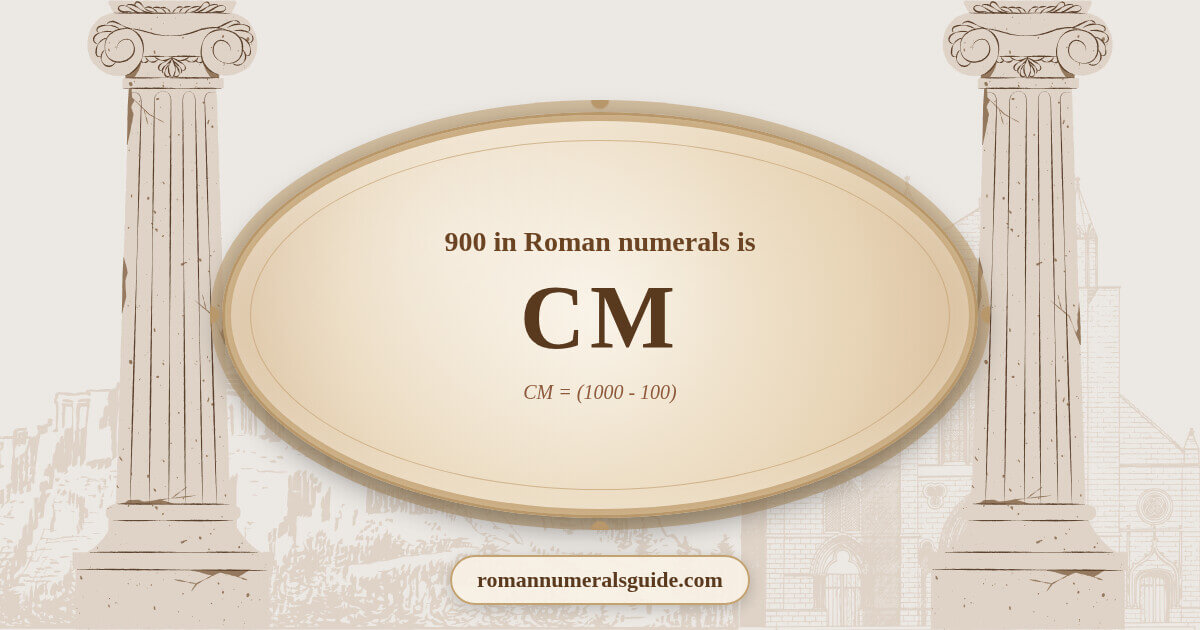
How to write 900 in Roman numerals: CM = 1000 - 100
How to Write 900 in Roman Numerals
To write 900 in Roman numerals, we use CM, which means M (1000) minus C (100). This subtractive notation is necessary because Roman numerals prohibit DCCCC, making CM the efficient solution.
The Roman numeral system represents 900 as CM, demonstrating the critical transition from additive notation (DCCC = 800) to subtractive notation, where C placed before M indicates subtraction.
Breaking Down 900 (CM)
Step-by-Step Breakdown
The number 900 demonstrates why Roman numerals transition to subtractive notation after DCCC (800). Since DCCCC would violate the three-repetition rule, CM efficiently represents 900 using just two symbols, showcasing the sophisticated logic of Roman numeral design.
Correct Representation
Incorrect Representations
Historical Significance
In ancient Rome, the number 900 held practical importance in military logistics and large-scale administrative calculations. Historical records reference quantities of 900 in supply inventories, troop deployments, and financial assessments, making CM a numeral that appeared in official documentation.
The year 900 AD (CM) marked a significant period in European history, occurring during the High Middle Ages. This era saw the consolidation of feudal systems, the continuation of Carolingian reforms, and the preservation of Roman numeral systems through monastic and ecclesiastical scholarship.
Evolution of 900 in Roman Numerals
The representation of 900 as CM reflects the standardization of subtractive notation that became firmly established in classical Roman numerals.
| Period | Notation | Context |
|---|---|---|
| Early Rome (753-300 BC) | DCCCC or CM | Both forms occasionally appeared before standardization |
| Classical Rome (300 BC - 476 AD) | CM | Subtractive notation became standard practice |
| Medieval Period (476 - 1453 AD) | CM | Consistent use in manuscripts and official documents |
| Modern Era (1453 - Present) | CM | Universal standard in all formal uses |
Cultural Applications
- Historical commemorations of 900-year anniversaries
- Page numbering in extensive academic and legal volumes
- Architectural documentation and classical building measurements
- Ceremonial inscriptions and memorial plaques
- Academic chapter and volume organization systems
Decimal System Comparison
The number 900 demonstrates how different numeral systems handle the transition from maximum repetition to efficient notation strategies.
- • Decimal 900: Three digits using positional notation (9 × 100)
- • Roman CM: Two symbols using subtractive notation (1000 - 100)
- • Efficiency gain: CM uses 2 symbols instead of 5 (DCCCC would be invalid)
- • Transition point: Represents shift from additive maximum to subtraction
The Transition to CM at 900
Understanding how Roman numerals progress from 800 to 900 reveals the critical transition from maximum additive notation to subtractive efficiency.
| Arabic | Roman | Explanation |
|---|---|---|
| 700 | DCC | Additive: 500 + 200 |
| 800 | DCCC | Maximum additive: 500 + 300 (three Cs) |
| 850 | DCCCL | Building on maximum: 800 + 50 |
| 900 | CM | Subtractive transition: 1000 - 100 (NOT DCCCC) |
| 950 | CML | Building on CM: 900 + 50 |
| 990 | CMXC | Combined: 900 + 90 |
| 1000 | M | Fundamental symbol: one thousand |
The transition at 900 (CM) represents a fundamental efficiency principle in Roman numerals: when maximum repetition is reached at DCCC (800), the system employs subtraction to maintain clarity and prevent invalid notation.
Why CM Instead of DCCCC
The number 900 perfectly illustrates the subtractive principle that prevents unwieldy repetitions beyond the three-symbol limit.
The Subtractive Rule at 900
- After DCCC (800), adding another hundred cannot use DCCCC
- Roman numerals prohibit four consecutive identical symbols
- C can be placed before M (1000) to indicate subtraction: CM = 900
- This pattern mirrors CD (400): both use subtraction at critical thresholds
- Subtractive notation maintains efficiency while ensuring clarity
Memory Tips for CM
Remembering that CM equals 900 becomes intuitive when you understand the subtractive pattern and why it is necessary.
The Subtraction Pattern
Think of CM as "Centum before Mille" (Latin for hundred before thousand). When a smaller value (C = 100) appears before a larger one (M = 1000), subtract: 1000 - 100 = 900.
Remember the parallel patterns: CD (400 = 500-100) and CM (900 = 1000-100). Both occur when maximum repetition is reached, demonstrating the consistent logic underlying Roman numeral efficiency.
900 in the Modern World
History
900-year anniversaries and historical milestone commemorations
Academia
Page numbering in extensive scholarly volumes and treatises
Architecture
Historical measurements in classical building documentation
Mathematical Significance
900 is a highly composite number with 27 divisors, making it exceptionally useful in practical calculations. Its prime factorization is 2² × 3² × 5² (4 × 9 × 25), demonstrating perfect square factors. The number 900 represents 9 × 100, making it fundamental in percentage calculations and decimal scaling. In geometry, 900 degrees equals 2.5 full rotations.
Mathematical Properties of 900
The number 900 possesses remarkable mathematical characteristics that make it significant in both pure and applied mathematics.
- Highly composite number with 27 divisors
- Prime factorization: 2² × 3² × 5² (4 × 9 × 25)
- Divisors: 1, 2, 3, 4, 5, 6, 9, 10, 12, 15, 18, 20, 25, 30, 36, 45, 50, 60, 75, 90, 100, 150, 180, 225, 300, 450, 900
- Even number divisible by many common values
- 900 = 30² (thirty squared), making it a perfect square
Did You Know?
The year 900 AD (CM) occurred during a period when European monasteries served as crucial centers for preserving classical knowledge, including Roman numeral systems. Monks copying manuscripts ensured the transmission of mathematical and linguistic traditions from ancient Rome through the medieval period, making CM part of a preserved heritage that continues to the present day.
The Transition at 900
Understanding how Roman numerals transition at 900 reveals the elegance and necessity of subtractive notation.
- DCCC (800) → DCCCL (850) → CM (900) → CML (950) → M (1000)
- CM marks the critical transition from maximum additive notation to subtraction
- Pattern parallels CD (400): both prevent invalid four-symbol repetitions
- Subtractive notation maintains elegance approaching M (1000)
Frequently Asked Questions
Why is 900 written as CM and not DCCCC?
Roman numerals have a strict rule prohibiting more than three consecutive repetitions of the same symbol. After DCCC (800), which uses three C symbols, the system cannot add a fourth C. CM means M (1000) minus C (100), equaling 900. This keeps the notation efficient and readable, using just two symbols instead of five invalid ones.
How do you remember that CM equals 900?
Remember the pattern: when a smaller symbol appears before a larger one, subtract. C (100) before M (1000) means 1000 - 100 = 900. This follows the same logic as CD (400 = 500-100). Both occur at critical thresholds where maximum repetition requires the shift to subtraction.
Why does 900 need subtraction while 800 uses addition?
DCCC (800) uses three C symbols, which is the maximum allowed repetition. To represent 900, you would need DCCCC (four Cs), which violates Roman numeral rules. Therefore, the system shifts to CM (1000 - 100), using subtractive notation to maintain efficiency and prevent invalid notation.
What is significant about the year 900 AD?
The year 900 AD (CM) occurred during the High Middle Ages, when European monasteries preserved classical knowledge, including Roman numeral systems. This period saw the consolidation of feudal structures and the continuation of Carolingian educational reforms that ensured the transmission of ancient Roman mathematical traditions.
How does CM relate to other subtractive notations?
CM (900) follows the same subtractive pattern as IV (4), IX (9), XL (40), XC (90), and CD (400). All use a smaller symbol before a larger one to indicate subtraction. CM represents the largest subtractive notation in the hundreds range before reaching M (1000).
Why is 900 a perfect square?
900 equals 30 × 30 (30²), making it a perfect square. This property, combined with its prime factorization 2² × 3² × 5² (showing three perfect square factors), makes 900 particularly useful in geometric calculations, area computations, and mathematical problems involving squares and square roots.
Summary
Key Points About CM
- CM represents 900 using subtractive notation (1000 - 100)
- Marks the transition from maximum additive to subtraction
- Cannot be written as DCCCC due to three-repetition limit
- Parallels CD (400) in structure and logical necessity
Modern Usage
- Academic page and volume numbering
- Historical anniversary commemorations
- Architectural and classical documentation
- Ceremonial inscriptions and memorial contexts
The Roman numeral CM (900) represents a pivotal demonstration of subtractive notation necessity and elegance. From the maximum additive form DCCC (800), the system transitions to CM to avoid the invalid DCCCC, showcasing the sophisticated logic underlying Roman numeral efficiency. From medieval monastic scholarship to modern academic publications, CM maintains relevance across centuries. Understanding CM reveals how Roman numerals balance systematic patterns with practical efficiency, creating a notation system that remains both logical and enduring. This number stands as a testament to the elegant design principles that make Roman numerals adaptable and comprehensible even after two millennia.
Converting number 900 to Roman
This is the number 900 written in Roman numerals
Try the Roman numeral converter
Want to convert other numbers? Use our converter: