
700 in Roman Numerals is DCC
The Roman numeral for 700 is DCC. This number demonstrates the systematic progression of additive notation, where D (500) is combined with CC (200) to create seven hundred.
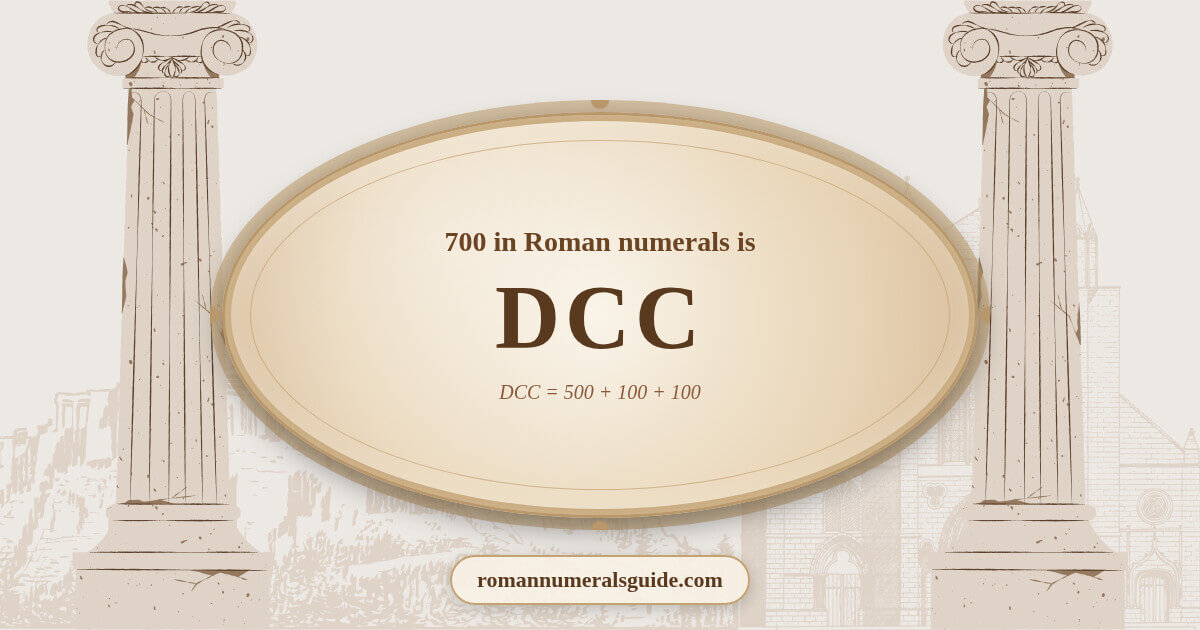
How to write 700 in Roman numerals: DCC = 500 + 200
How to Write 700 in Roman Numerals
To write 700 in Roman numerals, we use DCC, which combines D (500) with CC (200). This additive notation follows the logical pattern of building upon D by adding two C symbols.
The Roman numeral system represents 700 as DCC, showing systematic additive notation where D provides the base of 500, and CC adds 200 to reach seven hundred.
Breaking Down 700 (DCC)
Step-by-Step Breakdown
The number 700 demonstrates the continued application of additive Roman numeral principles. After D (500) and DC (600), the system logically adds another C to reach DCC (700), maintaining clarity and efficiency through straightforward addition.
Correct Representation
Incorrect Representations
Historical Significance
In ancient Rome, the number 700 appeared in historical records of the city's founding. Roman tradition held that Romulus founded Rome with an assembly of senators, and various historical accounts reference groups of 700 citizens in early Roman political organization.
The number 700 also appears in Roman military logistics and construction projects. Historical documents reference quantities of 700 in material inventories, troop deployments, and architectural measurements, making DCC a practical numeral in administrative and engineering contexts.
Evolution of 700 in Roman Numerals
The representation of 700 as DCC has maintained consistency throughout history, demonstrating the stability of Roman numeral additive patterns.
| Period | Notation | Context |
|---|---|---|
| Early Rome (753-300 BC) | DCC | Established in civic and military documentation |
| Classical Rome (300 BC - 476 AD) | DCC | Standard representation in official inscriptions |
| Medieval Period (476 - 1453 AD) | DCC | Consistent use in manuscripts and chronicles |
| Modern Era (1453 - Present) | DCC | Universal standard in formal contexts |
Cultural Applications
- Historical commemorations of 700-year anniversaries
- Page numbering in extensive academic and legal volumes
- Architectural documentation in classical building projects
- Ecclesiastical calendar calculations and feast day designations
- Literary volume and chapter organization
Decimal System Comparison
The number 700 illustrates the parallel between Roman additive notation and decimal positional systems.
- • Decimal 700: Three digits using positional notation (7 × 100)
- • Roman DCC: Three symbols using additive notation (500 + 200)
- • Pattern: DCC continues the logical D + multiples of C progression
- • Clarity: Additive structure remains transparent and readable
Understanding Hundreds Around 700
Understanding how Roman numerals progress around 700 reveals the systematic continuation of the additive pattern building upon D (500).
| Arabic | Roman | Explanation |
|---|---|---|
| 600 | DC | D + C: 500 + 100 |
| 650 | DCL | DC + L: 600 + 50 |
| 700 | DCC | D + CC: 500 + 200 (additive notation) |
| 750 | DCCL | Building on DCC: 700 + 50 |
| 800 | DCCC | D + CCC: 500 + 300 |
| 900 | CM | Transition to subtraction: 1000 - 100 |
The progression shows DCC (700) as a natural continuation of the D + C pattern, maintaining additive clarity before the transition to subtractive notation at CM (900).
Why DCC Uses Addition
The number 700 demonstrates the efficient application of additive Roman numeral principles within repetition limits.
The Additive Rule at 700
- DCC follows proper descending value order
- Two C symbols after D remain within the three-repetition limit
- Additive notation remains efficient and clear
- The pattern continues systematically: DC, DCC, DCCC
- No need for subtractive notation until 900 (CM)
Memory Tips for DCC
Remembering that DCC equals 700 becomes intuitive when you understand the systematic progression from D (500).
The Addition Pattern
Think of DCC as "D plus two Cs" - when values descend from left to right, you add them: 500 + 100 + 100 = 700. This follows the same logic as DC (600) with one additional C.
Remember the sequence: DC (600), DCC (700), DCCC (800). Each step adds one C symbol until you reach three repetitions at 800, after which the system transitions to CM (900) using subtraction.
700 in the Modern World
Academia
Page numbering in extensive scholarly volumes and treatises
History
700-year anniversaries and historical milestone commemorations
Architecture
Historical measurements in classical building documentation
Mathematical Significance
700 is a highly composite number with 12 divisors (1, 2, 4, 5, 7, 10, 14, 20, 25, 28, 35, 50, 70, 100, 140, 175, 350, 700). Its prime factorization is 2² × 5² × 7, making it useful in various practical calculations. The number 700 represents a significant milestone as 7 × 100, appearing frequently in measurement systems and historical documentation.
Mathematical Properties of 700
The number 700 possesses mathematical characteristics that make it practical in both historical and modern contexts.
- Composite number with 18 divisors
- Prime factorization: 2² × 5² × 7 (4 × 25 × 7)
- Divisors: 1, 2, 4, 5, 7, 10, 14, 20, 25, 28, 35, 50, 70, 100, 140, 175, 350, 700
- Even number divisible by common values
- 700 = 7 × 100, making it significant in percentage and scaling calculations
Did You Know?
The year 700 AD (DCC) marked a significant period in European history, occurring during the early Middle Ages. This was an era of cultural transformation, with the continued spread of Christianity, the development of monastic scholarship, and the preservation of classical Roman texts that included Roman numeral documentation.
The Additive Pattern at 700
Understanding how Roman numerals build around 700 reveals the systematic nature of the hundreds progression.
- D (500) → DC (600) → DCC (700) → DCCC (800) → CM (900)
- DCC continues the D + C additive pattern with two C symbols
- Pattern maintains clarity and efficiency through systematic addition
- Additive notation continues until maximum repetition at DCCC (800)
Frequently Asked Questions
Why is 700 written as DCC and not another way?
DCC is the standard representation because it efficiently combines D (500) with CC (200) using clear additive notation. This follows the natural progression: DC (600), DCC (700), DCCC (800), maintaining consistency within Roman numeral rules.
How do you remember that DCC equals 700?
Remember the pattern: D is 500, and each C adds 100. DCC means D plus two Cs: 500 + 100 + 100 = 700. Think of the sequence DC (600), DCC (700), DCCC (800) - each step adds one C.
Why does 700 use two C symbols instead of something else?
Roman numerals build logically from fundamental symbols. After D (500), adding C symbols is the natural way to represent hundreds. DCC efficiently uses two C symbols for 200, staying within the three-repetition limit while maintaining clear additive structure.
What is significant about the year 700 AD?
The year 700 AD (DCC) occurred during the early Middle Ages, a period of cultural development in Europe. It was an era when monastic communities preserved classical knowledge, including Roman numeral systems, through manuscript copying and scholarly work.
Is DCC still used today?
Yes, DCC appears in academic works for page numbering in extensive volumes, historical commemorations marking 700-year anniversaries, and formal documentation where Roman numerals maintain traditional or ceremonial significance.
How does DCC relate to DC and DCCC?
DCC is part of a systematic sequence: DC (600) uses one C, DCC (700) uses two Cs, and DCCC (800) uses three Cs. This demonstrates the logical progression of Roman numeral additive notation before transitioning to subtractive notation at CM (900).
Summary
Key Points About DCC
- DCC represents 700 using additive notation (500 + 200)
- Follows the pattern: DC, DCC, DCCC
- Two C symbols remain within repetition limits
- Maintains systematic progression from D (500)
Modern Usage
- Academic page and volume numbering
- Historical anniversary commemorations
- Architectural and classical documentation
- Formal and ceremonial contexts
The Roman numeral DCC (700) demonstrates the systematic elegance of additive notation in the hundreds range. By combining D (500) with CC (200), Roman numerals efficiently represent seven hundred with clear logical structure. From ancient Roman civic records to modern academic publications, DCC maintains its role in formal contexts. Understanding DCC reveals how Roman numerals build methodically through addition, creating patterns that remain accessible and practical across centuries. This number sits comfortably in the additive progression before the system transitions to subtractive notation at 900.
Converting number 700 to Roman
This is the number 700 written in Roman numerals
Try the Roman numeral converter
Want to convert other numbers? Use our converter: