
800 in Roman Numerals is DCCC
The Roman numeral for 800 is DCCC. This number represents the maximum use of additive C symbols after D, demonstrating the three-repetition limit before Roman numerals transition to subtractive notation.
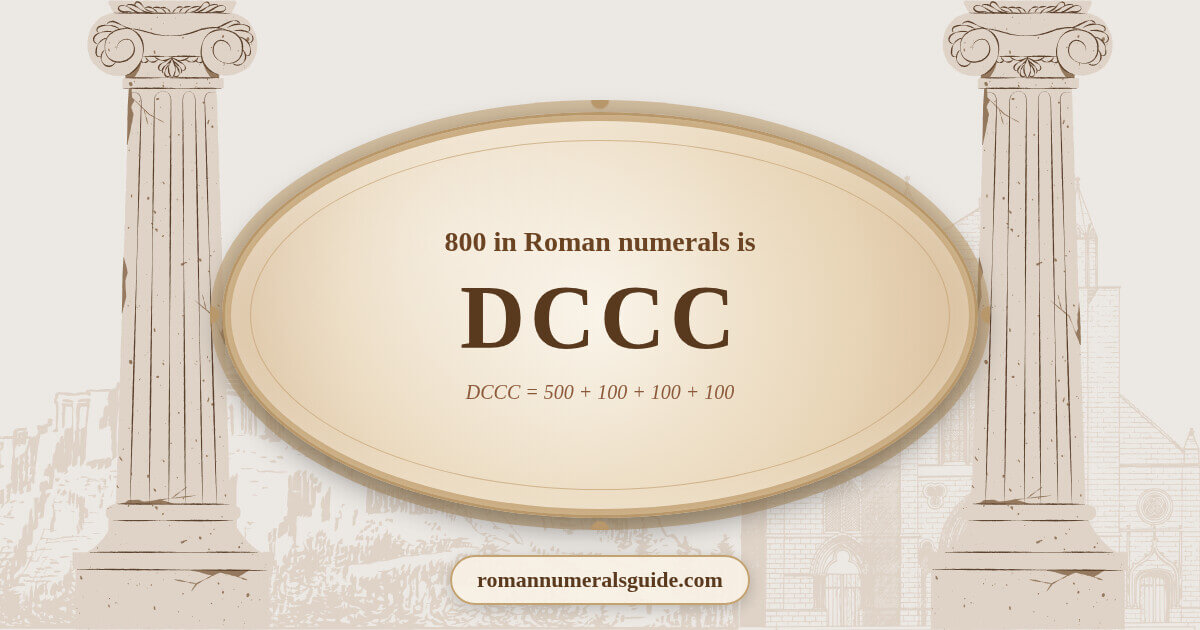
How to write 800 in Roman numerals: DCCC = 500 + 300
How to Write 800 in Roman Numerals
To write 800 in Roman numerals, we use DCCC, which combines D (500) with CCC (300). This notation reaches the maximum allowed repetition of C symbols, demonstrating the boundary where additive notation meets its limit.
The Roman numeral system represents 800 as DCCC, showing the maximum application of additive notation where D provides 500, and three C symbols add 300 to reach eight hundred.
Breaking Down 800 (DCCC)
Step-by-Step Breakdown
The number 800 demonstrates the three-repetition limit that governs Roman numeral construction. DCCC uses the maximum allowed three C symbols, marking the boundary beyond which the system must employ subtractive notation, as seen with CM (900).
Correct Representation
Incorrect Representations
Historical Significance
In ancient Rome, the number 800 held significance in military organization and civic administration. Historical records reference groups of 800 soldiers in legion formations, and 800 appears in census documentation, property assessments, and public works projects.
The year 800 AD (DCCC) marks one of the most significant dates in European history: the coronation of Charlemagne as Holy Roman Emperor on Christmas Day. This event, documented extensively in medieval chronicles using Roman numerals, symbolized the revival of imperial authority in Western Europe and the formal beginning of the Holy Roman Empire.
Evolution of 800 in Roman Numerals
The representation of 800 as DCCC has remained remarkably stable throughout history, demonstrating the consistent application of the three-repetition limit.
| Period | Notation | Context |
|---|---|---|
| Early Rome (753-300 BC) | DCCC | Established in administrative and military records |
| Classical Rome (300 BC - 476 AD) | DCCC | Standard representation in official inscriptions |
| Medieval Period (476 - 1453 AD) | DCCC | Consistent use marking the coronation year of Charlemagne |
| Modern Era (1453 - Present) | DCCC | Universal standard demonstrating maximum additive repetition |
Cultural Applications
- Historical commemorations of 800-year anniversaries
- The year 800 AD marking Charlemagne's coronation as Holy Roman Emperor
- Academic page numbering in extensive scholarly volumes
- Architectural measurements in classical documentation
- Legal and ecclesiastical document organization
Decimal System Comparison
The number 800 illustrates the parallel between maximum Roman additive notation and decimal positional systems.
- • Decimal 800: Three digits using positional notation (8 × 100)
- • Roman DCCC: Four symbols using maximum additive notation (500 + 300)
- • Boundary: DCCC represents the limit before subtractive notation (CM = 900)
- • Efficiency: Maximum repetition while maintaining readability
Understanding the Transition from 800 to 900
Understanding how Roman numerals progress from 800 to 900 reveals the critical transition from maximum additive notation to subtractive efficiency.
| Arabic | Roman | Explanation |
|---|---|---|
| 700 | DCC | D + CC: 500 + 200 |
| 750 | DCCL | DCC + L: 700 + 50 |
| 800 | DCCC | D + CCC: 500 + 300 (maximum C repetition) |
| 850 | DCCCL | Building on DCCC: 800 + 50 |
| 900 | CM | Transition to subtraction: 1000 - 100 (NOT DCCCC) |
| 1000 | M | Fundamental symbol: one thousand |
DCCC (800) represents the maximum additive form before the system transitions to CM (900) using subtractive notation, illustrating the three-repetition rule that prevents DCCCC.
Why DCCC Is the Maximum Before Subtraction
The number 800 perfectly demonstrates the three-repetition limit that necessitates the transition to subtractive notation at 900.
The Three-Repetition Limit at 800
- DCCC uses three C symbols, reaching the maximum allowed repetition
- Roman numerals prohibit four consecutive identical symbols
- After DCCC (800), adding another hundred requires subtractive notation
- The next value, 900, must be written as CM (1000 - 100), not DCCCC
- This demonstrates why the three-repetition rule maintains efficiency
Memory Tips for DCCC
Remembering that DCCC equals 800 becomes clear when you understand it represents the maximum additive form before the system shifts to subtraction.
The Maximum Addition Pattern
Think of DCCC as "D plus three Cs" - this is the maximum you can add C symbols after D. When values descend from left to right, you add them: 500 + 100 + 100 + 100 = 800.
Remember the critical transition: DCCC (800) is the last pure additive form. The next hundred, 900, must use CM (subtraction) because DCCCC is not allowed. This makes DCCC a boundary marker in Roman numeral structure.
800 in the Modern World
History
Year 800 AD: Charlemagne crowned Holy Roman Emperor, pivotal European historical moment
Academia
Page numbering in extensive scholarly works and historical texts
Technology
800 number toll-free telephone prefix system in North America
Mathematical Significance
800 is a highly composite number with 18 divisors (1, 2, 4, 5, 8, 10, 16, 20, 25, 40, 50, 80, 100, 160, 200, 400, 800). Its prime factorization is 2⁵ × 5² (32 × 25), making it exceptionally useful in practical calculations. The number 800 appears in toll-free telephone systems (800 numbers) and represents 8 × 100, a significant milestone in scaling and percentage calculations.
Mathematical Properties of 800
The number 800 possesses mathematical characteristics that make it valuable in both theoretical and practical contexts.
- Highly composite number with 18 divisors
- Prime factorization: 2⁵ × 5² (32 × 25)
- Divisors: 1, 2, 4, 5, 8, 10, 16, 20, 25, 40, 50, 80, 100, 160, 200, 400, 800
- Even number divisible by many common values
- 800 = 8 × 100, fundamental in decimal scaling
Did You Know?
The 800 toll-free telephone number prefix, introduced in 1967, became one of the most recognized number sequences in North America. While not directly related to Roman numerals, the number 800 gained cultural significance as synonymous with free customer service calls, demonstrating how specific numbers can acquire practical meaning beyond their mathematical value.
The Maximum Additive Pattern at 800
Understanding how Roman numerals reach 800 reveals the systematic application of the three-repetition limit.
- D (500) → DC (600) → DCC (700) → DCCC (800) → CM (900)
- DCCC represents maximum C repetition after D
- Three C symbols mark the boundary where addition must give way to subtraction
- The transition to CM (900) demonstrates the efficiency principle
Frequently Asked Questions
Why is 800 written as DCCC and not DCCCC?
Roman numerals prohibit more than three consecutive repetitions of the same symbol. DCCC uses three C symbols, reaching the maximum allowed. A fourth C would violate this fundamental rule, which is why 900 must be written as CM (1000 - 100) using subtractive notation instead of DCCCC.
How do you remember that DCCC equals 800?
Remember the sequence: D is 500, and each C adds 100. DCCC means D plus three Cs: 500 + 100 + 100 + 100 = 800. Think of DCCC as the maximum additive form - three Cs is the limit before switching to subtraction at CM (900).
Why is the year 800 AD historically significant?
The year 800 AD (DCCC) marks the coronation of Charlemagne as Holy Roman Emperor on Christmas Day. This pivotal event symbolized the revival of imperial authority in Western Europe and the formal beginning of the Holy Roman Empire, representing a crucial turning point in medieval European history.
What makes DCCC special in Roman numeral structure?
DCCC demonstrates the three-repetition limit that governs Roman numeral efficiency. It represents the maximum additive notation before the system transitions to subtractive patterns. After DCCC (800), the next hundred (900) must use CM, not DCCCC, illustrating a fundamental principle of Roman numeral design.
Are 800 numbers related to Roman numeral DCCC?
No, 800 toll-free telephone numbers are not directly related to Roman numerals. However, both demonstrate how the number 800 has acquired practical significance - DCCC in historical documentation and mathematics, and 800 numbers in modern telecommunications as a widely recognized toll-free prefix.
How does DCCC relate to DC and DCC?
DCCC completes the systematic sequence: DC (600) uses one C, DCC (700) uses two Cs, and DCCC (800) uses three Cs - the maximum allowed. This demonstrates the logical progression of Roman additive notation before the necessary transition to CM (900) using subtraction.
Summary
Key Points About DCCC
- DCCC represents 800 using maximum additive notation (500 + 300)
- Uses three C symbols, reaching the repetition limit
- Marks the boundary before transition to subtractive notation
- Cannot be written as DCCCC due to three-repetition rule
Modern Usage
- Historical reference to Charlemagne's coronation (800 AD)
- Academic page numbering in extensive volumes
- Architectural and historical documentation
- Cultural anniversary commemorations
The Roman numeral DCCC (800) represents a crucial boundary in Roman numeral notation, demonstrating the maximum application of additive principles before the system must employ subtractive efficiency. By combining D (500) with three C symbols (300), DCCC reaches the three-repetition limit that defines Roman numeral structure. From Charlemagne's historic coronation in 800 AD to modern academic documentation, DCCC maintains significance across centuries. Understanding DCCC reveals the elegant logic underlying Roman numeral design - the systematic progression through addition (DC, DCC, DCCC) followed by the necessary transition to subtraction (CM) that prevents unwieldy repetitions while preserving clarity and efficiency.
Converting number 800 to Roman
This is the number 800 written in Roman numerals
Try the Roman numeral converter
Want to convert other numbers? Use our converter: