
2028 in Roman Numerals is MMXXVIII
The number 2028 in Roman notation is MMXXVIII. This number uses pure additive notation, combining millennium (MM), tens (XX), and units (VIII) to represent an upcoming year that will host the Los Angeles Summer Olympics, marking the third time the city welcomes the world's greatest sporting event.
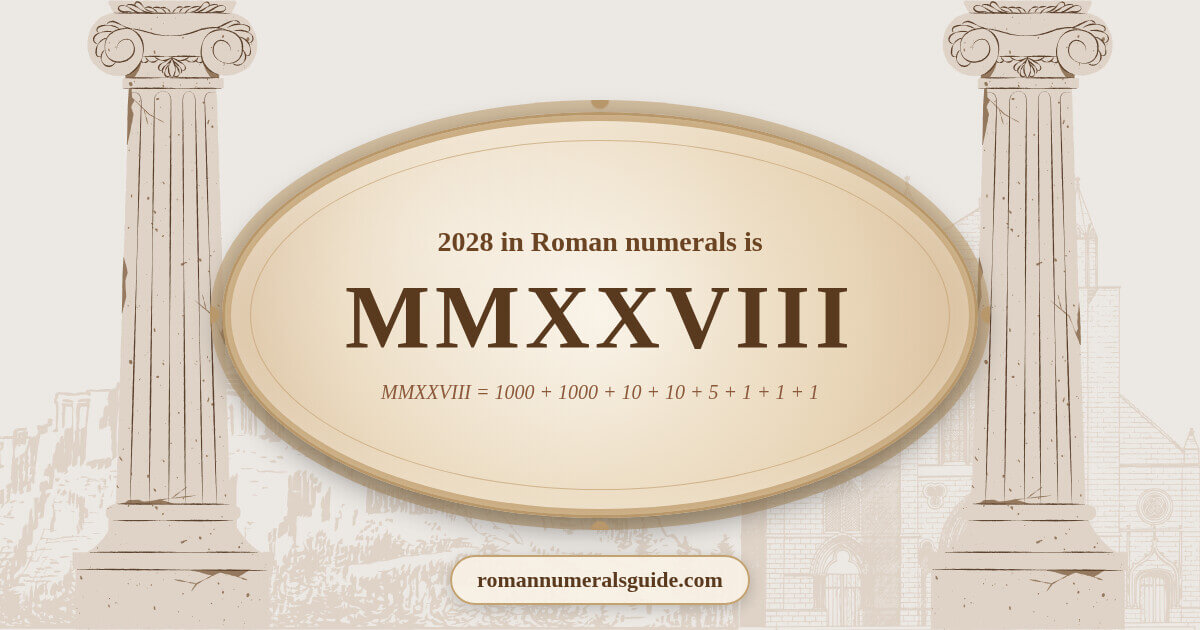
The number 2028 written in Roman numerals as MMXXVIII
How do we write 2028 in Roman numerals?
The number 2028 in Roman notation (MMXXVIII) is constructed using additive principles, where symbols are combined from largest to smallest to create the total value.
Breaking down MMXXVIII:
Step-by-Step Breakdown:
The number MMXXVIII uses pure additive notation, where all symbols are simply added together from left to right. The final component VIII represents 8 by combining V (5) with three instances of I (1 + 1 + 1), demonstrating the maximum repetition allowed for I after V in Roman numerals.
Major Events in 2028
The year MMXXVIII will be highlighted by the return of the Summer Olympics to Los Angeles:
Los Angeles 2028 Summer Olympics
The Games of the XXXIV Olympiad will take place from July 14-30, 2028, marking Los Angeles' third time hosting the Olympics (after 1932 and 1984). This will be the first Summer Olympics held in the United States since Atlanta 1996.
New Olympic Sports Debut
Flag football and squash will make their Olympic debut, while baseball/softball, cricket (first time since 1900), and lacrosse (first medal event since 1908) return to the Olympic program.
Historic Venues Without New Construction
LA 2028 will utilize existing facilities with no new permanent venues built. SoFi Stadium will host swimming as the largest swimming venue in Olympic history, while the LA Memorial Coliseum becomes the first stadium to host three Olympics.
Key Facts about 2028
Important characteristics of the year MMXXVIII:
- 2028 is a leap year (divisible by 4, will have 366 days)
- Prime factorization: 2² × 3 × 13²
- Uses only additive notation (no subtractive principles)
- VIII shows maximum I repetition: three I's after V
- Los Angeles hosts Summer Olympics for the third time
Correct and incorrect notations for 2028
Correct notation:
Incorrect notations:
Comparing MMXXVIII with nearby years
Notice how 2028 represents the last purely additive year before 2029 introduces subtractive notation:
- • 2025 = MMXXV (all additive)
- • 2026 = MMXXVI (all additive)
- • 2027 = MMXXVII (all additive)
- • 2028 = MMXXVIII (all additive - maximum I repetition)
- • 2029 = MMXXIX (uses subtractive IX)
- • 2030 = MMXXX (all additive)
Where You Will See MMXXVIII
The Roman notation MMXXVIII will appear prominently throughout 2028:
- Los Angeles 2028 Olympics branding and official materials
- Olympic medals, certificates, and commemorative items marked MMXXVIII
- LA Memorial Coliseum inscriptions marking its third Olympics
- Copyright notices for films, TV shows, and books published in 2028
- Building cornerstones and monument inscriptions dated 2028
- Academic publications and formal legal documents
How to remember MMXXVIII (2028)?
To easily remember that 2028 is written as MMXXVIII:
- • MM = 2000 (double millennium marker)
- • XX = 20 (two tens)
- • VIII = 8 (five plus three ones: V + I + I + I)
- • Think "two thousand, twenty-eight" → MM-XX-VIII
- • Remember: VIII uses the maximum of three I's after V
Practical tip:
MMXXVIII is the last year in the 2020s decade to use only additive notation. The VIII ending demonstrates the Roman numeral rule that you can repeat I up to three times after V. After VIII comes IX, which switches to subtractive notation. This makes 2028 a perfect example of the boundary where Roman numerals transition from pure addition to subtraction.
MMXXVIII compared to other numbers
Comparing 2028 (MMXXVIII) with nearby years shows the transition point in Roman numeral patterns:
| Number | Roman numeral | Structure type |
|---|---|---|
| 2026 | MMXXVI | Pure additive (MM + XX + VI) |
| 2027 | MMXXVII | Pure additive (MM + XX + VII) |
| 2028 | MMXXVIII | Pure additive (MM + XX + VIII) - maximum I repetition |
| 2029 | MMXXIX | Mixed: additive + subtractive (MM + XX + IX) |
| 2030 | MMXXX | Pure additive (MM + XXX) |
| 2031 | MMXXXI | Pure additive (MM + XXX + I) |
MMXXVIII marks the transition point where Roman numerals reach the maximum repetition of I (three times) before switching to subtractive notation with IX in 2029. This makes it particularly significant for understanding Roman numeral construction rules.
Frequently Asked Questions about MMXXVIII (2028)
Why is 2028 written as MMXXVIII?
MMXXVIII uses the additive principle where MM represents 2000, XX represents 20, and VIII represents 8. The number 8 is written as VIII (5 + 1 + 1 + 1), using V for 5 and three I's for the remaining 3. This follows the Roman numeral rule allowing up to three consecutive repetitions of I after V.
What makes 2028 special in Roman numerals?
MMXXVIII is the last year in the 2020s to use only additive notation. With VIII, it demonstrates the maximum allowed repetition of I (three times) after V. The following year, 2029 (MMXXIX), switches to subtractive notation, making 2028 a boundary year in Roman numeral patterns.
Is 2028 a leap year?
Yes, 2028 is a leap year because it is divisible by 4. It will have 366 days with February having 29 days. This makes MMXXVIII significant for calendar applications.
How do you write 2028 step by step?
Start with the thousands: MM (2000), add the tens: XX (20), then add the units: VIII (8). To write VIII, combine V (5) with three I's (1 + 1 + 1). Result: MM + XX + VIII = MMXXVIII.
What major events will happen in 2028?
The year MMXXVIII will host the Los Angeles 2028 Summer Olympics (July 14-30), marking LA's third Olympics after 1932 and 1984. The Games will feature new sports including flag football and squash, and the return of baseball/softball, cricket, and lacrosse. No new permanent venues are being built.
Why does VIII use three I's?
Roman numerals allow repeating the same symbol up to three times for addition. After V (5), you can add up to three I's to create VI (6), VII (7), and VIII (8). Four I's would violate this rule, which is why 9 uses subtractive notation (IX) instead of VIIII.
How is MMXXVIII different from MMXXIX (2029)?
MMXXVIII (2028) uses pure additive notation where VIII = 5 + 1 + 1 + 1. MMXXIX (2029) introduces subtractive notation where IX = 10 - 1 = 9. This difference shows the transition from maximum additive repetition to subtraction in Roman numerals.
Why will the 2028 Olympics be special?
LA 2028 will make Los Angeles the first city to host three Summer Olympics. It will be the first Summer Olympics in the US since 1996, feature new sports (flag football, squash), and use only existing venues with no new construction. SoFi Stadium will become the largest Olympic swimming venue in history.
Summary
The Roman numeral MMXXVIII represents the number 2028 through straightforward additive notation while demonstrating the maximum repetition of I symbols. This upcoming leap year, marked by the historic Los Angeles 2028 Summer Olympics, exemplifies how Roman numerals bridge ancient tradition with modern celebration. MMXXVIII stands as a boundary year that perfectly illustrates the transition from pure addition to subtractive notation in Roman numeral construction.
Converting number 2028 to Roman
This is the number 2028 written in Roman numerals
Try the Roman numeral converter
Want to convert other numbers? Use our converter: